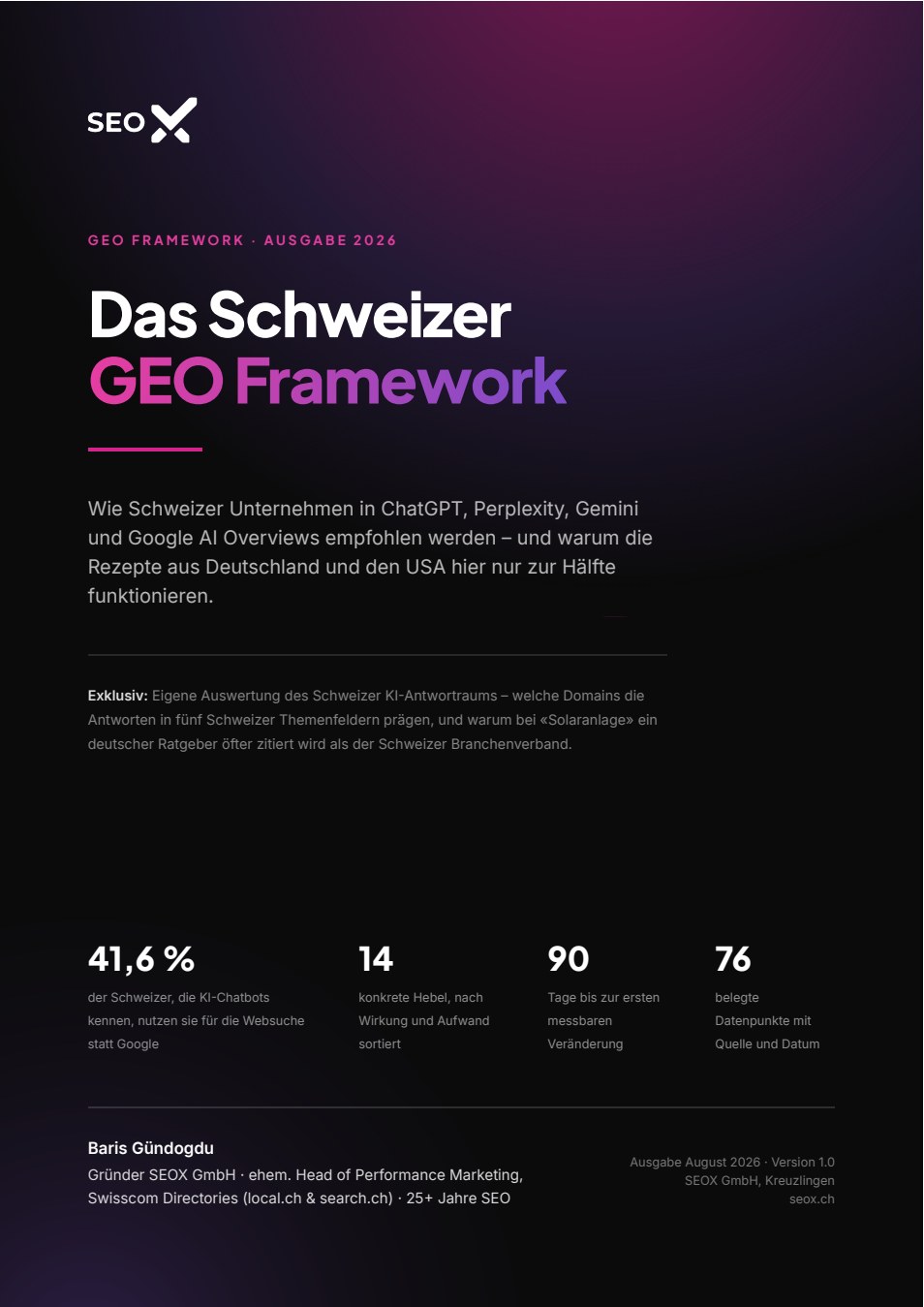
More and more people in Switzerland ask AI instead of Google – for providers, prices and recommendations. If you are missing from these answers, you do not exist for these customers, however good your Google rankings are. On 66 pages, the Swiss GEO Framework shows you how to change that: with Swiss data, Swiss examples and a plan you can put into practice right away.
After the first 20 pages you know whether your company has an AI visibility problem. After 66 pages you know what to do about it – and in which order. The PDF is in German.
We have sent an email (in German) to your address. One click on the confirmation link and the framework is on its way. If needed, check your spam folder.
Agency and project experience from mandates and previous positions at
Press:
On Google there were ten places on the first page – whoever searched also saw you. An AI answer works differently: it recommends a handful of names, and the customer contacts exactly those. They no longer see a list where you appear further down. They do not see you at all.
This happens every week – with customers who would have been a good fit for you. They ask AI about your service, get three names and call one of them. Whether your name is among them decides whether you still exist for these customers at all.
Find out whether you get namedGEO stands for Generative Engine Optimization: making sure AI assistants such as ChatGPT know and recommend your company. What SEO was for Google, GEO is for AI search – and in Switzerland its own rules apply. If you approach them with German recipes, your website becomes yet another German signal. How to spot the difference:
For AI, Swiss spelling is not a cosmetic detail but a way to assign you to a market. Anyone who delivers German texts with ß to you is sorting you towards Germany.
Prices in francs, deadlines and legal references under the Swiss Code of Obligations instead of the German Civil Code – this is how AI recognizes whether your content applies to Switzerland or to its neighbor.
comparis.ch, local.ch, moneyland.ch – in Switzerland the models draw on different sources than in Germany. If you maintain the wrong ones, your effort goes nowhere.
81.6 percent AI use in French-speaking Switzerland compared with 74.1 in German-speaking Switzerland. If you make revenue there, you need your own content – not translations.
Microsoft Copilot reads from the Bing index – and Bing is clearly stronger in Switzerland than in Germany. A side issue there, a channel of its own here.
Chapter 8.5 takes you through every single signal – from hreflang de-CH to the company ID (UID) in the legal notice. Tick them off, no prior knowledge needed.
We measured whom AI actually names as a source for people in Switzerland – in five everyday topics from health insurance to solar systems, with up to 30 top sources evaluated per topic. There was no public study on this, so we measured it ourselves. The result: in four out of five topics, German websites appear among the top sources.
| Topic (Switzerland) | German domains among the top sources | Most striking case |
|---|---|---|
| Mortgage | 0 of 30 | Entirely Swiss sources |
| Health insurance | 4 of 15 | barmer.de, aok.de, verbraucherzentrale.de (data basis here: top 15) |
| Moving house | 10 of 30 | umzugspreisvergleich.de, sirelo.de |
| Dentist | 10 of 30 | zahnarzt-weilimdorf.de – a single practice in Stuttgart |
| Solar system | 12 of 30 | solaranlage-ratgeber.de in position 2 – ahead of swissolar.ch |
Own analysis of the SISTRIX AI database, country code ch, models Google AI Overviews and AI Mode, queried on August 3, 2026. Topic-based prompt sets, not a representative sample of the Swiss search space.
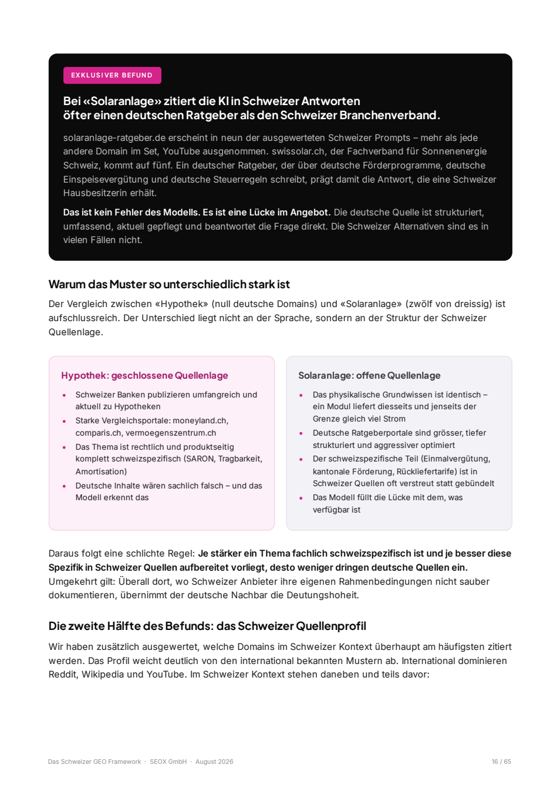
For “Solaranlage” (solar system), AI cites a German guide more often in Swiss answers than the Swiss industry association.
This points to a gap in Swiss-specific sources: where Swiss information is missing or less well prepared, AI systems often fall back on more extensive German sources. That is exactly where the opportunity lies for Swiss companies. Chapter 3 of the framework shows the full data and what follows from it.
66 pages you do not have to read in one go. Each part answers a question you are asking yourself right now – and ends with something you can do straight away.
Real Swiss figures on how many of your customers already search with AI – and the 10-minute self-test: ask AI ten customer questions and see for yourself whom it recommends. Then you know whether you have a problem before you spend a single franc.
The four-phase plan: measure first, then technology, then content, then keep at it. The order protects you from investing money in the wrong place – the most common mistake with this topic.
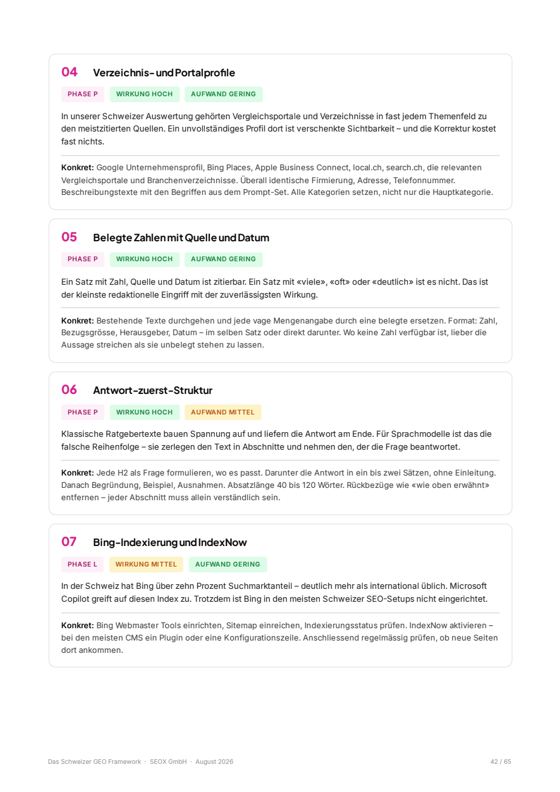
14 concrete actions, sorted by impact and effort. Each one states who implements it and how long it takes – so you can hand it straight to your web agency or IT and know what you are ordering.
Eight things that are often sold and demonstrably bring little – with the numbers to show it. This chapter alone saves you more than the PDF would cost, if it cost anything.
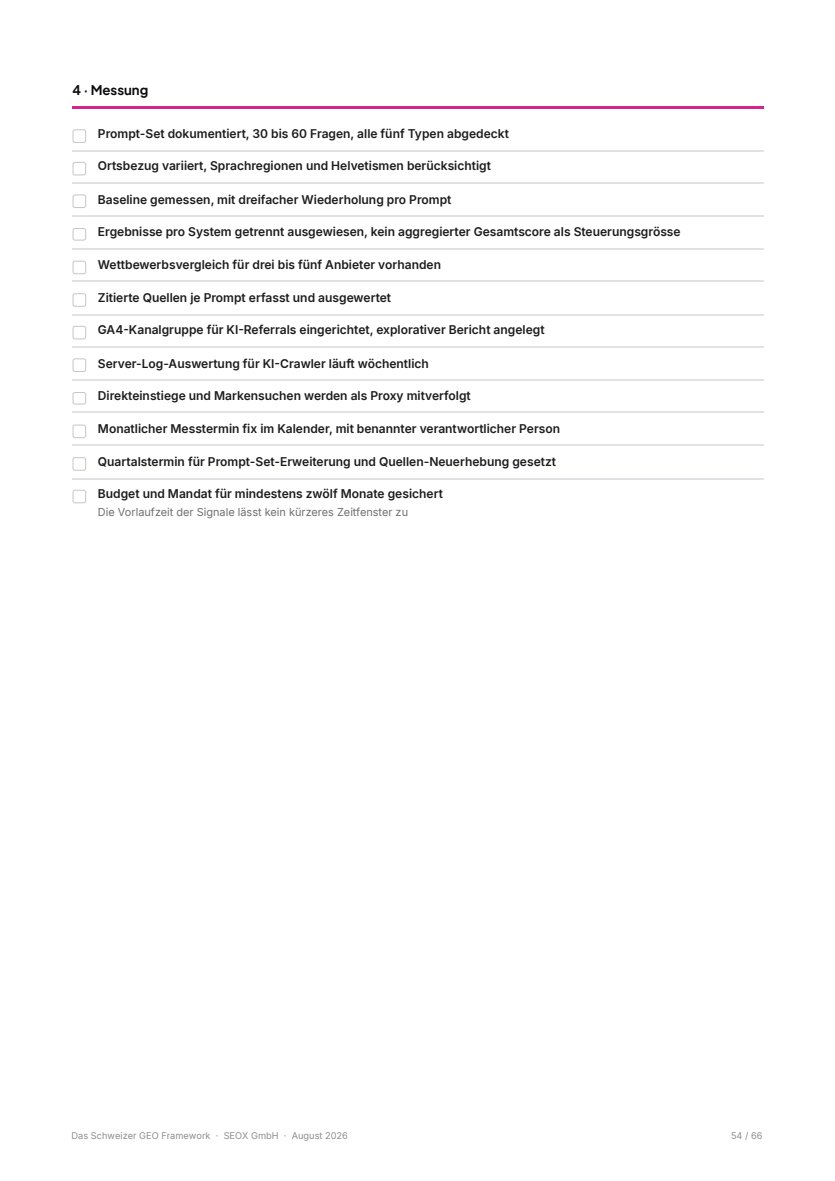
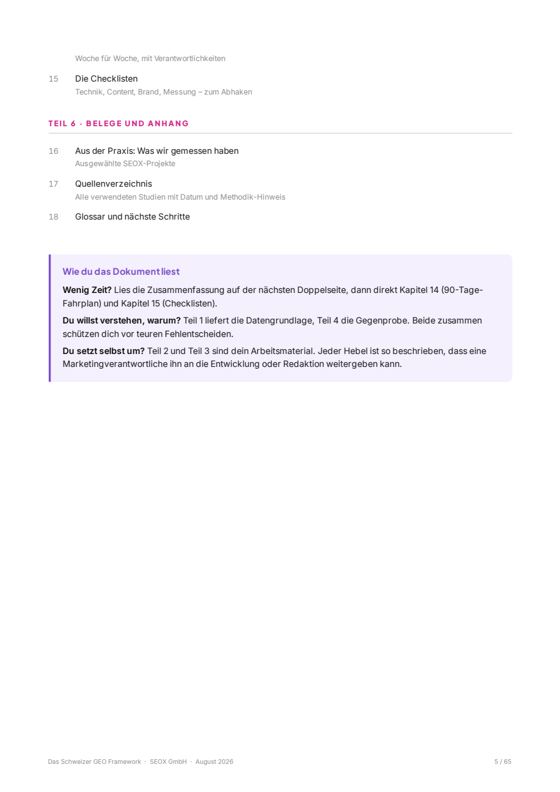
The 90-day roadmap as a calendar: what happens in week 1, what in week 8, who is responsible. Plus four checklists to print and tick off – usable without prior knowledge.
Every figure in the document with source and date so you can check it, a glossary for all terms – and honest notes where a study is weak. You can verify everything yourself.
This is what the pages you work with look like: every action is in the document as a ready-made guide – with impact, effort and who implements it. Much of it you can do in an hour, without an agency.
GEO does not suit every business. For some it already brings in customers today, for others the money is better invested elsewhere. So you do not lose time, here is the honest assessment:
“As part of a large group, we searched for a long time for a competent SEO expert who understands our requirements and can help us in a targeted way. With SEOX we have finally found the right partner.”
“We have valued SEOX's professionalism and know-how since 2023 and would not want to be without the team. SEOX makes sure we get very good advice on using our advertising budget in a targeted and effective way.”
“Thanks to the collaboration, we were able to strengthen our online presence considerably and win new customers. The optimization led to a clear increase in traffic and conversions.”
Quotes translated from German.
Nothing. The complete 66-page document is free. For the download we need your first name and your email address. You only receive updates on new editions if you explicitly tick the box when downloading.
No. It is the complete framework with all 14 levers, the 90-day roadmap, the four checklists and the full list of sources. There is no paid full version that we want to sell you afterwards.
No. The technical chapters are written so that a marketing manager can understand them and pass them on to the developers. Wherever it gets technical, it says who implements the action and how long it takes.
We measured the Swiss AI answer space ourselves and show which domains shape the answers in five Swiss topics. On top of that come the Swiss particularities: the clearly higher Bing share, the different AI adoption between German-speaking Switzerland and Romandy, and concrete actions Swiss companies can take to improve their chances of being considered a relevant source themselves.
No. After the download you only receive a message about new editions or new Swiss data, about once a quarter, if you explicitly ticked the box when downloading. You can unsubscribe at any time with one click.
Partly, and we disclose it, because transparency belongs in a text about AI systems. AI systems were used for research, data analysis and drafting. The figures on the Swiss AI answer space come from SEOX GmbH's own tool queries. Baris Gündogdu read the entire document, checked every statement for accuracy, verified every figure against the original source (several dates and methodology details were corrected in the process) and approved the publication. Editorial responsibility lies with SEOX GmbH. The full notice is in the document itself, at the front with the foreword and in detail in the imprint.
As of August 2026. All studies are listed with their survey period and publication date, and where a source has methodological limitations, this is noted. Our own analysis of the Swiss AI answer space dates from August 3, 2026.
The framework works without us too. If you want to know how your company appears in AI answers today and which sources shape your topic, we measure it for you – free and without obligation.
Result within 48 hours · personal assessment by SEOX · at most 5 initial analysis places per month