
E-E-A-T in the context of AI search
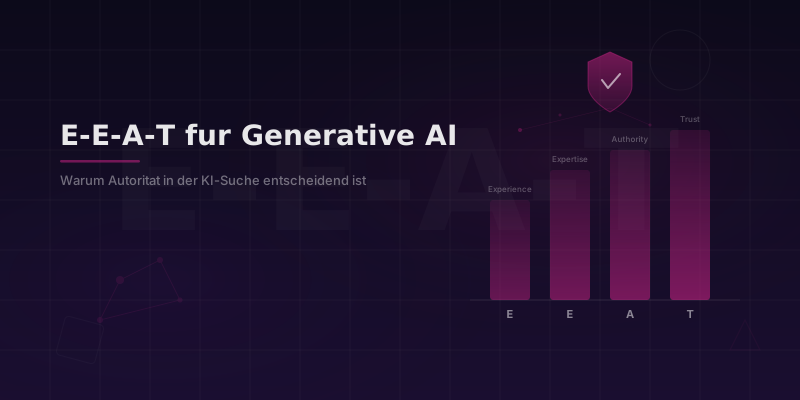
E-E-A-T stands for Experience, Expertise, Authoritativeness and Trustworthiness. Google has used it as a quality criterion for years, and it matters even more in AI search. With every answer, an AI search engine has to decide which few sources it cites, and E-E-A-T signals are the filter that decides.
Classic search engines show ten results per page. AI assistants typically cite only 1–3 sources per answer, so the competition for those few spots is much tougher. Only sources that are rated as especially trustworthy and competent make it into the AI answer.
The 4 pillars of E-E-A-T applied to AI answers
1. Experience
AI systems assess whether the author of a piece of content has real experience with the topic. So show authentic hands-on experience: client projects, case studies, personal assessments based on years of work. AI models can tell generic knowledge apart from expertise that comes from doing the work.
2. Expertise
Demonstrate deep knowledge of your field. Use technical terms correctly, give detailed explanations and show that you really understand the subject. Author profiles with qualifications, certifications and lists of publications strengthen your expertise signal considerably.
3. Authoritativeness
Authority comes from outside confirmation. That includes backlinks from recognized websites, mentions in trade media, citations in academic papers and positive reviews. AI systems crawl the web and assess how often, and by whom, your company is referenced. A high domain authority tells AI systems that you are a relevant voice in your industry.
4. Trustworthiness
Trust is the foundation. That includes HTTPS, a transparent legal notice and privacy policy, verifiable facts and a consistent presentation of your company across the web. AI systems prefer sources that don't spread contradictory information and whose statements can be verified.
Practical checklist: strengthening E-E-A-T for AI search
Concrete measures you can put in place right away:
- Create author profiles: every expert article needs a named author with a short bio, qualifications and a photo
- Add Schema.org Person markup: connect author profiles with structured data, so AI engines can tie the content to a known person and entity
- Cite your sources: link to studies, statistics and recognized sources
- Publish case studies: show real results with figures and context
- Write guest articles on trade portals: build outside authority through link building and PR
- Update regularly: outdated content signals a lack of care
Case study: E-E-A-T in practice
A Swiss financial advisor implemented the measures above over a period of four months. The result: AI visibility rose by 340%. Before the optimization, the company was not named as a source for any of the 30 industry questions tested in ChatGPT or Perplexity. After the optimization, it appeared among the top 3 sources for 12 of the 30 questions.
The key was the combination of technical measures (schema markup, author profiles) and content quality (case studies, data-based analyses, expert opinions).
In AI search, E-E-A-T is a must-have, not a nice-to-have. If you want to appear as a source in AI answers, you have to show trust, expertise and authority in a way that can be verified.
For more depth, read our article E-E-A-T score: how Google evaluates your expertise. Or find out in What is GEO? how E-E-A-T fits into your overall GEO strategy. As an SEO & GEO agency, we strengthen your company’s E-E-A-T signals step by step.
You can also learn how to build a GEO strategy as an SME and which content formats AI systems prefer.