
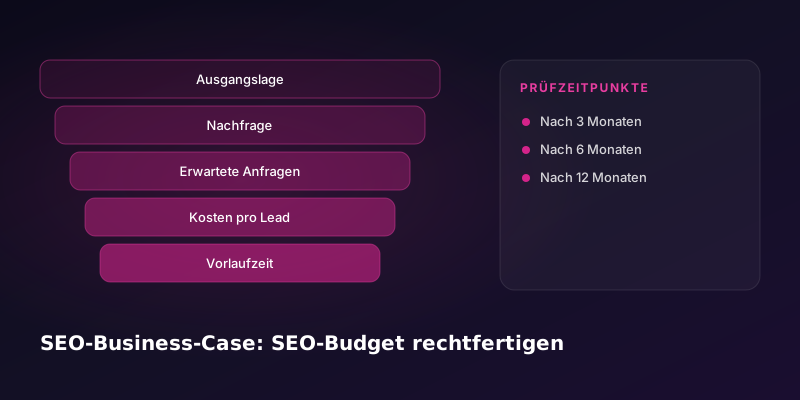
- An SEO business case works with leads and cost per lead, not rankings. Rankings are an intermediate step.
- It has five building blocks: starting point, demand, expected leads, cost per lead and lead time.
- SEO ROI is the contribution margin of the customers you win, minus the costs, divided by the costs.
- Agree on review points after 3, 6 and 12 months, with metrics that can realistically be measured at each point.
This guide helps you justify an SEO budget internally: with a calculation management can follow, and with metrics they can use to judge success later. What SEO costs in Switzerland is covered in the guide SEO Costs in Switzerland. This article is about the calculation logic.
Why SEO budgets fail on the wrong metric
Many SEO budgets are justified with rankings: "We want to be on page 1 for these ten terms." That sounds measurable, but it doesn't answer management's question of what the company gets out of it. If rankings rise and leads stay flat, SEO is seen as a failure. The same happens if leads rise but nobody attributes them to search.
A business case holds up when it speaks the same language as other investments: What does it cost, what does it bring, when, and how do we know whether it works? For that, you don't need industry statistics, you need your own numbers.
The five building blocks of an SEO business case
- Starting point: How many clicks and leads does organic search bring today? Your sources are Google Search Console and Google Analytics. If leads are not tracked properly yet, fixing that is the first step.
- Demand: How often do people search for your services, and where do you rank for those terms today? Keyword tools provide search volumes, Search Console provides positions.
- Expected leads: How many additional visits are realistic with better positions, and what share of those visitors will get in touch? The conversion rate of your existing pages is the best basis.
- Cost per lead: Budget divided by additional leads. Compare this number with the cost per lead from Google Ads, trade fairs or cold outreach.
- Lead time: When can you expect first results? Google writes that some changes take effect within hours while others take several months (SEO Starter Guide). So plan the ramp-up phase in explicitly.
How to calculate SEO ROI: the method with example values
The method in plain words: count the additional leads from organic search and multiply them by your close rate and the contribution margin per customer. Subtract the SEO costs and divide the result by the costs. That is your ROI.
An example with made-up values, only to illustrate the method:
| Assumption (fictional) | Value |
|---|---|
| SEO budget | CHF 2,400 per month, 12 months = CHF 28,800 |
| Additional qualified leads | from month 7, an average of 6 per month = 36 in the first year |
| Close rate | 20% = about 7 new customers |
| Contribution margin per new customer in the first year | CHF 6,000 = CHF 42,000 |
| Cost per lead | CHF 28,800 / 36 = CHF 800 |
| ROI in the first year | (CHF 42,000 − CHF 28,800) / CHF 28,800 = about 46% |
Plug in your own values. Two points belong in every honest calculation: in the first year, costs start in month 1, but leads only arrive later. And pages that rank keep bringing leads after the first year, as long as they are maintained. So also calculate a 24-month version.
SEO vs. paid: cost per lead compared
| Channel | Cost logic | Lead time | Effect after the budget stops |
|---|---|---|---|
| SEO | Fixed monthly costs; cost per lead falls as the number of leads grows | Weeks to months | Rankings and leads last for a while, but decline without maintenance |
| Google Ads | Cost per click; cost per lead stays similar if competition stays the same | Immediately after approval | Ads and leads stop when the budget stops |
The two channels complement each other: Google Ads delivers leads right away and shows which search terms actually turn into customers. SEO builds lasting visibility for exactly those terms. Where you invest first depends on how quickly you need leads. Tips for the paid channel are in the guide Google Ads for SMEs.
Is SEO worth it for niche manufacturers and small markets?
Often especially there. In small markets, search volumes are low, but so is the competition. Someone searching for a specific component, a standards test or niche software usually has a concrete need. With high order values, just a few leads a year can carry the business case. So don't calculate with visitor numbers, calculate with the value of a single lead. The business case stays honest if you also check the "not enough demand" scenario: if hardly anyone searches for your services, SEO is not the right main channel.
How much budget is realistic?
That depends on competition, the number of topics and your starting point. The business case helps you turn the question around: what budget can be justified given your cost per lead and your contribution margin? Specific prices and budget levels are in the guide SEO Costs in Switzerland and on the SEOX pricing page. For optimizing for AI answers, there is a separate guide on GEO costs in Switzerland.
Template: the business case on one page
- Goal: Which services should bring more leads through search?
- Starting point: organic clicks and leads over the last 12 months.
- Demand: search volume and current positions for the most important terms.
- Assumptions: additional leads, close rate, contribution margin per customer, each with a source or marked as an estimate.
- Costs: monthly budget and one-off costs.
- Calculation: cost per lead and ROI after 12 and 24 months, with a cautious and an expected scenario.
- Comparison: cost per lead from other channels.
- Review points: metrics after 3, 6 and 12 months, and who decides.
What management measures after 3, 6 and 12 months
| Point in time | What can realistically be measured | Source |
|---|---|---|
| After 3 months | Implementation of the planned measures, indexing, impressions and first position gains | Search Console, list of measures |
| After 6 months | Clicks on the pages you worked on, first additional leads | Search Console, Google Analytics |
| After 12 months | Leads, cost per lead and closed deals from organic search compared with the plan | Google Analytics, CRM |
These are review points, not promises. What matters is agreeing in advance which metric counts when. To attribute leads to search, you need clean tracking all the way to the inquiry. How that works is described on the Web Analytics page. If you don't want to handle the implementation yourself, ongoing SEO management takes care of it.
Updated: November 9, 2026 · Author: Baris Gündogdu, founder of SEOX GmbH
Sources: Google Search Central, Search Engine Optimization (SEO) Starter Guide, developers.google.com, accessed November 9, 2026. All values in the example calculation are made up and only serve as an illustration.