
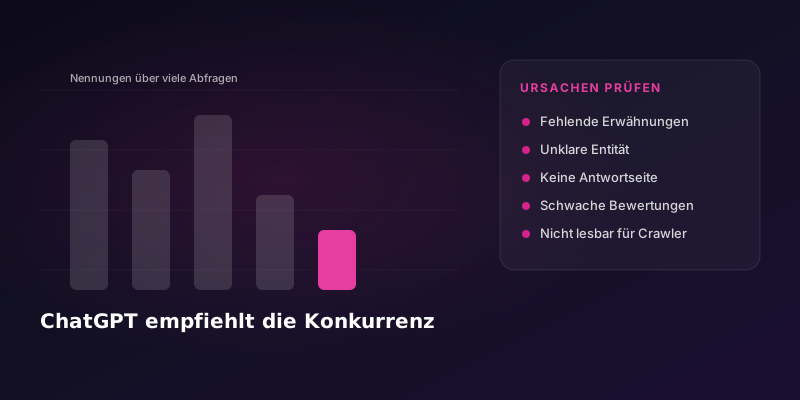
- ChatGPT recommends providers it finds in its sources. If you are missing from comparison articles, directories and trade media, you will rarely be named, even with a well-optimized website.
- There is no fixed ranking in ChatGPT; what you measure is how often a system names a company across many queries.
- FAQs and structured data are basic hygiene. A controlled study by Ahrefs found no meaningful increase in AI citations after schema was added.
- Getting into the recommendations takes four steps: measure, close source gaps, build answer pages, earn mentions.
You ask ChatGPT for the best providers in your industry and region, and the answer names three competitors. Your company is missing. This guide explains where these recommendations come from, which causes are most common and why FAQs and schema alone rarely change anything. If you would rather hand off the diagnosis: as a GEO agency in Switzerland, this is exactly the question we work on, and the starting point is a GEO/LLMO audit.
Why does ChatGPT name your competitors?
AI recommendations follow the sources the system finds for a question. When ChatGPT answers with web search, it reads pages such as comparison articles, industry directories, review profiles and trade articles and summarizes which providers appear there. If you appear in several of these sources in the right context, you are more likely to end up in the answer. How AI search systems choose their sources is explained in the guide AI search systems and source selection.
That is why a well-optimized website of your own is often not enough. Ahrefs analyzed 15,000 prompts: on average, only 12% of the links cited by ChatGPT, Gemini and Copilot also ranked in Google's top 10 for the same question (Ahrefs, August 2025). Good Google rankings and AI recommendations are related, but they are not the same thing.
In a second analysis of 75,000 brands, Ahrefs found that web mentions of a brand correlate much more strongly with its visibility in ChatGPT, AI Mode and AI Overviews than its number of backlinks (Ahrefs, December 2025). That is a correlation, not proof of cause and effect. But it shows where to look: outside your website.
The five most common causes when ChatGPT recommends competitors
| Cause | How you recognize it | What helps |
|---|---|---|
| Missing mentions in comparison articles and directories | The sources ChatGPT links in its answer name your competitors, but not you | Get listed in the directories, portals and comparison articles that are cited for your industry |
| Unclear entity | ChatGPT describes your company incorrectly, confuses it with another or doesn't know what you offer | Keep your name, offering, location and description consistent on your website, profiles and directories |
| No answer to the question on your website | For "best provider for X in Y" you have no page that clearly states your service, region and target group | Pages that answer exactly these questions directly |
| Weak reviews and profiles | Competitors have more and more recent reviews on Google and industry portals | Actively ask for reviews, keep profiles complete |
| Content not readable for AI crawlers | Important content only loads via JavaScript, or robots.txt blocks AI crawlers | Check robots.txt, deliver core content directly in the HTML |
We added FAQs and schema. Why isn't it working?
Because FAQ sections, structured data and a readable website are hygiene. They help machines understand your content, but on their own they rarely get you into a recommendation. Ahrefs tracked 1,885 pages that added JSON-LD schema between August 2025 and March 2026 and compared them with 4,000 control pages. On none of the platforms studied did citations rise meaningfully as a result (Ahrefs, May 2026). Google itself states that there are no additional technical requirements for AI Overviews and AI Mode and that the usual SEO fundamentals still apply (Google Search Central).
If results stall despite this work, the bottleneck is usually the sources the system draws on for your industry. If your name appears in none of them, the system has little reason to mention you, no matter how cleanly your own website is structured.
Diagnosis: check which sources are behind the recommendations
Before you plan any measures, look at the sources. Ask ChatGPT, Perplexity and Gemini the questions your customers would ask, with web search turned on, and note which pages the answers link to. Repeat this several times, because the answers vary. After a few rounds, you will see which directories, comparison articles and media keep coming up in your industry, and which of them list your competitors. We do this systematically, across many questions and systems, in prompt mapping.
How to get recommended by ChatGPT in four steps
- Measure: Make a list of the questions your customers ask and regularly check how often each system names your company. Measure the share of answers that include your company, not a position.
- Close source gaps: Make sure you are listed in the directories, portals and comparison articles that are cited for your industry, with correct and consistent details.
- Build answer pages: On your website, directly answer the questions that lead to recommendations: what you offer, for whom, where and what sets you apart.
- Earn mentions: Expert articles, interviews and your own data in media that allow AI crawlers. The guide Digital PR for AI visibility shows how.
There is no fixed ranking in ChatGPT; what you measure is how often a system names a company across many queries. SparkToro had 600 volunteers run twelve prompts a total of 2,961 times through ChatGPT, Claude and Google's AI search. The probability that ChatGPT or Google's AI named the same list of brands twice for the same question was below 1 in 100 (SparkToro, January 2026). How to turn this into a metric for sales is covered in the guide Winning new customers through ChatGPT. How AI systems talk about your brand is shown by a brand sentiment analysis.
Example: a fiduciary firm in Zurich
The following example is constructed and does not describe a real company. A fiduciary and accounting firm in Zurich notices that ChatGPT names three other firms when asked "best fiduciary Zurich". The answers link to an industry directory, a comparison article on a business portal and Google review profiles. The firm is listed in the directory with an old address, is missing from the comparison article and has far fewer reviews than the firms that were named. Its website describes its services but mentions neither its target group nor its areas of specialization.
This leads to the measures: correct the directory listing, ask to be included in the comparison article, ask satisfied clients for reviews and build a page that describes fiduciary services for SMEs in Zurich with clear details. Nobody can guarantee that ChatGPT will name the firm afterwards. What you can measure is whether the share of answers that include the firm goes up. For more on the finance and fiduciary sector, see SEO and GEO for financial service providers.
As of November 9, 2026 · Author: Baris Gündogdu, founder of SEOX GmbH
Sources: Ahrefs, Only 12% of AI Cited URLs Rank in Google’s Top 10 for the Original Prompt, August 11, 2025, ahrefs.com; Ahrefs, Top Brand Visibility Factors in ChatGPT, AI Mode, and AI Overviews (75k Brands Studied), December 12, 2025, ahrefs.com; Ahrefs, We Tracked 1,885 Pages Adding Schema. AI Citations Barely Moved., May 11, 2026, ahrefs.com; Google Search Central, AI features and your website, developers.google.com; SparkToro, AIs are highly inconsistent when recommending brands or products, January 28, 2026, sparktoro.com.