
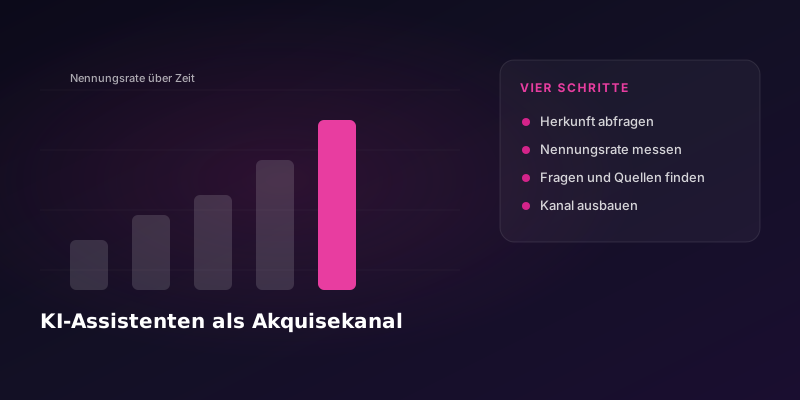
- Leads from AI assistants barely show up in analytics, because many people read the answer and visit you later directly or through Google.
- The simplest measuring point is the first call: ask how the person found you, and offer “AI assistant” as an answer in your form.
- Mention rate: the share of queries in which a system names your company. It replaces the ranking, which does not exist in ChatGPT.
- You grow the channel through answers on your website and mentions in sources that AI systems read.
A new client tells you in the first call that ChatGPT recommended you. That is good news, but it is not yet a channel. This guide shows how to make leads from AI assistants visible, how to measure how often the systems name you, and how to turn that into predictable leads. We offer the implementation as a GEO agency in Switzerland.
Signs that customers come to you through AI assistants
- Prospects say in conversation that they found you through ChatGPT, Perplexity or an AI search.
- Inquiries use wording that does not come from your website, such as a summary of what you offer.
- In analytics, individual visits appear with referrers such as chatgpt.com or perplexity.ai.
- Searches for your company name or direct visits go up without you doing more advertising.
None of these signs proves anything on its own. If several appear together, it is worth taking a closer look.
Why leads from ChatGPT barely show up in analytics
If someone clicks a link to your website in a ChatGPT answer, analytics can recognize the visit as a referral. But often nobody clicks. The person reads the recommendation, remembers the name and later searches for you on Google or types the address directly. In analytics, this appears as a visit from Google Search or as a direct visit, and the real source stays hidden.
With Google’s own AI answers, there is one more factor: Search Console counts visits from AI Overviews and AI Mode as part of the overall search traffic under the “Web” search type (Google Search Central). If you look for the channel only in analytics, you will almost always underestimate it. Measuring where leads come from properly is part of our web analytics service.
Get new customers through ChatGPT in four steps
- Ask about the source in the first call and in your form.
- Measure your mention rate across many queries.
- Find out which questions and sources are behind the recommendations.
- Grow the channel with answer pages and mentions.
Step 1: Ask about the source in the first call and in your form
The most reliable measuring point is the person themselves. Add a required or optional field to your contact form and ask in the first call. A template for the field “How did you find us?” with these answer options:
- Google Search
- AI assistant (ChatGPT, Perplexity, Gemini, Copilot)
- Recommendation from friends or clients
- Social media
- Event or trade fair
- Other (free text)
Copy the answer into your CRM as a field. Then you can see later how many leads and closed deals come from this channel. In the first call, a second question is worth asking: what did you ask the AI? The answer shows you the wording your customers use when they search.
Step 2: Measure your mention rate
The mention rate is the share of queries in which a system names your company. To measure it, put together a list of the questions your customers ask and run each question several times in each system. A single screenshot tells you little, because the answers vary a lot.
How much they vary is shown by a SparkToro study: across 2,961 runs of twelve prompts, the probability that ChatGPT or Google’s AI named the same list of brands twice was less than 1 in 100. SparkToro therefore considers visibility as a percentage across many prompts and runs to be a useful metric (SparkToro, January 2026). Measure each system separately, because the systems draw on different sources. The guide how to measure AI visibility describes the method in detail.
Step 3: Find out which questions and sources are behind the recommendations
Once you know how often you are named, the next question is why. Which questions lead to recommendations in your industry, and which pages do the answers link to? Often these are business directories, comparison articles and review platforms. We map questions to sources in our prompt mapping service. Reverse search intent engineering shows how to work back from the question to the intent behind it.
If the systems mostly name your competitors, the guide why ChatGPT recommends your competitors covers the typical causes.
Step 4: Grow the channel with content and mentions
You grow the channel in two places. On your website, you need pages that answer the questions you found directly: what you offer, for whom, in which region and what sets you apart. Outside your website, you need mentions in the sources that get cited for your industry, for example through expert articles, interviews or data of your own. The guide digital PR for AI visibility explains how.
Then measure again. Put the mention rate per system next to the lead sources from your CRM. If the mention rate goes up but you get no more leads with the source “AI assistant”, the questions you track do not match what your customers actually ask.
AI recommendations as a second pillar next to word of mouth
If winning new customers depends almost entirely on personal recommendations, you rely on happy clients mentioning you at the right moment. AI recommendations work in a similar way. The difference: the recommendation comes from a system that summarizes publicly available sources.
The two complement each other. Happy clients write reviews, name you as a reference and mention you in posts, and these are exactly the traces an AI system finds. So ask happy clients for a review, a reference on your website or a short quote for a case study. That way, a recommendation made in conversation becomes a source an AI can read too.
Updated: November 9, 2026 · Author: Baris Gündogdu, founder of SEOX GmbH
Sources: Google Search Central, AI features and your website, developers.google.com; SparkToro, AIs are highly inconsistent when recommending brands or products, January 28, 2026, sparktoro.com.