
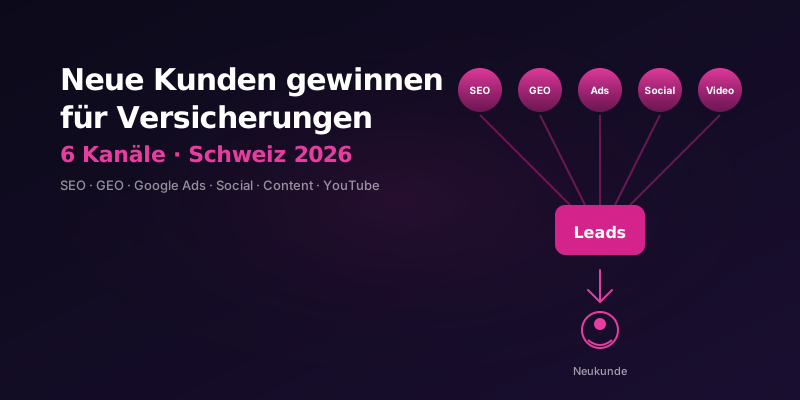
Short answer: In 2026, Swiss insurance brokers, general agencies and direct insurers win new customers through six channels: local SEO (Google Business Profile), content marketing (guides, comparisons), Google Ads, LinkedIn and Meta ads, YouTube explainer videos and, new on the list, GEO/LLMO for visibility in ChatGPT, Perplexity and Google AI Overviews. Which channel comes first depends on your line of business (health, life, property or commercial insurance), your audience and your sales model. This guide shows which levers pay off in which setup, and which compliance traps (the revised Swiss data protection act and FINMA supervision) you need to know.
Why cold calling no longer carries insurance sales in 2026
The Swiss insurance market has changed fundamentally over the last five years. In the 2000s, cold calls, door-to-door visits and trade-show stands were the norm. Today, Swiss consumers check providers online before the first contact: Comparis comparisons, Google reviews, recommendations in Reddit forums and, since 2024, more and more recommendations from ChatGPT and Perplexity. That is the search journey of an insurance buyer now. If you are not visible in these channels, you simply don't make the shortlist.
Two regulatory shifts add to this. The revised Federal Act on Data Protection (revFADP, in force since September 1, 2023) tightens the rules for processing personal data, which makes purchased lead lists a risky business. And FINMA, the Swiss financial market supervisor, has raised the requirements for transparency, advice documentation and commission disclosure as part of the revised Insurance Contract Act (VVG). Inbound marketing models, where customers actively ask for advice, carry far less risk under these rules than classic cold outreach.
The 6 most important acquisition channels for insurers in 2026
1. Local SEO & Google Business Profile: the underrated channel
If you run a general agency, a brokerage or an independent advisory office with a physical location, start with local SEO, not Google Ads. Local searches such as “insurance advice Zurich”, “compare health insurance Bern” or “pillar 3a advice Lucerne” mostly end up in the local pack (the box with three map results at the top). If you are not in it, you lose 44% of all clicks on local searches.
The main levers: a complete Google Business Profile with every line of business listed as a category, regular posts on current topics (premium negotiations, taxes and retirement savings, tips for claims), active review management (compliant with FINMA and data protection rules: never mention insurance details in public replies), a structured Q&A section, and photos of the office and the team. Our detailed guide to local SEO in Switzerland covers this step by step.
2. Content marketing: trust before the sale
Insurance is a classic high-trust product. People don't switch health insurers because a banner flashes. They switch when someone has explained their situation properly. That is what content marketing does. Guides such as “Which health insurer fits my family?”, “Pillar 3a with an insurer or a bank: which pays off?” or “What does household contents insurance really cover after water damage?” reach customers early in their decision. Comparison and advice content of this kind is the core of insurance SEO.
What matters for Swiss insurance content: a clear separation of the legal frameworks (KVG for basic health insurance, VVG for private insurance contracts, UVG for accident insurance, BVG for occupational pensions), Swiss Standard German for German-language pages, and references to official sources such as the Federal Office of Public Health (FOPH), FINMA, the Federal Social Insurance Office (FSIO) and the Federal Department of Finance (FDF). A single 1,500-word guide with correct cross-references can attract hundreds of qualified visitors a month. It is also the foundation for visibility in AI answers (see channel 6).
3. Google Ads: a controlled but expensive lead flow
In 2026, Google Ads remains the most direct source of new customers, because search intent is easy to measure. Someone who types “switch health insurance” or “calculate contents insurance” has a clear goal. The catch: insurance CPCs in Switzerland are high.
| Line of business | Cost-per-lead range (CHF) | Typical conversion (lead → contract) |
|---|---|---|
| Health insurance (switching insurer) | 30 – 80 | 15 – 25% |
| Contents / personal liability | 15 – 40 | 20 – 30% |
| Pillar 3a retirement savings | 50 – 150 | 10 – 18% |
| Life and term life insurance | 80 – 200 | 5 – 12% |
| SME / business insurance (B2B) | 150 – 400 | 3 – 8% |
These ranges come from industry benchmarks for 2025/26 and vary widely by region, season (the health insurance switching period in November), competition and Quality Score. A professional campaign structure with disciplined match types, negative keywords and well-maintained landing pages typically cuts costs by 30–50%. Read more under Google Ads.
Organic leads from SEO and content marketing cost more during the build-up phase, but less than CHF 20 per lead after 12–18 months.
4. LinkedIn and Meta ads: targeted B2B and lifestyle acquisition
For SME insurance, BVG occupational pensions, cyber insurance and liability, LinkedIn is essential in 2026. Three levers work: Sales Navigator for targeted outreach to managing directors and CFOs, organic content with industry updates (risk trends, compliance) and LinkedIn Ads with job title targeting. Keep in mind: the revFADP does not allow unauthorized data scraping. Outreach needs a relevant point of connection (shared contacts, an industry event, your own content).
Meta ads (Facebook, Instagram) suit consumer lines with a lifestyle angle: travel, car and contents insurance, or young adults opening their first pillar 3a account. Custom audiences from your own contact lists (with valid consent under data protection law), lookalike audiences and lead form ads are the usual tools.
5. YouTube: explainer videos that build trust
Insurance explainer videos on YouTube are underrated. A 4-minute video such as “KVG vs. VVG explained” or “How pillar 3a works in Switzerland” brings visibility, and ChatGPT and Perplexity increasingly cite such videos as sources. Tip: show your face. Insurance customers buy from people, not logos.
On the technical side: clean subtitles (in Swiss Standard German, ss instead of ß, for German-language videos), chapter markers for navigation, and a description that links to in-depth guides on your own website. Even small channels with 500 subscribers can generate measurable leads on niche topics.
6. GEO / LLMO: visibility in AI answers (the new must-have channel)
In 2026, someone asking “Which health insurer is cheapest for families in Zurich?” increasingly gets the answer from ChatGPT, Perplexity, Google AI Overviews or Gemini, not from the classic list of search results. Generative Engine Optimization (GEO) and Large Language Model Optimization (LLMO) make sure that insurance brokers and agencies are cited in these AI answers as trustworthy sources.
The method differs from classic SEO: language models prefer well-structured data (Schema.org), clear definitions, transparent authorship with proven expertise (E-E-A-T) and fact references to authoritative sources such as the FOPH, FINMA or Comparis studies. With aimaco.ai, SEOX runs its own AI visibility monitoring tool. It measures whether, and how often, an insurance brand is cited for each line of business. Read more under LLMO and What is GEO?
Lead magnets that work for insurers
In the insurance market, a good lead magnet is the entry point to an advice conversation. Four formats have proven themselves:
- Premium comparison / cost calculator: interactive tools that give an indicative premium estimate after you enter age, place of residence and family status (EXAMPLE: “Health insurance 2026 quick comparison”).
- Industry checklist as a PDF: for example “11 points your SME needs to cover against cyber risks” or “Pillar 3a check for 30- to 40-year-olds”.
- Risk analysis quiz: a short online quiz with a personal results PDF after the visitor enters an email address.
- Webinar / recording: structured 30-minute sessions on niche topics (retiring at 50, homeowner insurance, self-employment and retirement savings).
Keep in mind: every lead magnet needs a FINMA-compliant mandatory notice (an advice disclaimer), and email consent must be collected in line with the revFADP, with a separate opt-in, not hidden in the terms and conditions.
Data protection and FINMA compliance: what insurance brokers must watch in online marketing
Three rules you cannot skip:
- Don't process personal data without a clear legal basis. Purchased lead lists without complete consent records are risky. An inspection can lead to fines of up to CHF 250,000 (revFADP Art. 60). Your own inbound leads through transparent forms are the safe alternative.
- Disclose commissions. Since the VVG revision, insurance intermediaries must communicate their compensation structure transparently. Marketing copy that hides this point is a FINMA issue and also costs you customers' trust.
- Handle reviews lawfully. You may reply to Google reviews, but never with insurance details about the person. Customer confidentiality and personality rights apply. Generic, professional replies are the standard.
What a realistic acquisition strategy costs Swiss insurers in 2026
An integrated multi-channel strategy for a mid-sized Swiss insurance broker or general agency typically costs:
- Local SEO + Google Business Profile: CHF 1,500–2,500 / month for agency support
- Content marketing (4 guides + 2 comparison articles per month): CHF 3,000–5,000 / month
- Google Ads (media budget from CHF 3,000, setup + optimization from CHF 1,500): CHF 4,500–10,000 / month in total
- LinkedIn / Meta ads: from CHF 2,000 media + CHF 1,000 management
- GEO/LLMO: from CHF 1,800 / month (see SEOX packages)
A realistic start is a 90-day pilot with local SEO plus one additional channel (usually Google Ads for the health insurance switching period or LinkedIn for B2B insurance), with a budget of CHF 5,000–10,000 / month during the build-up phase. After that, you scale the channels that deliver ROI.
Insurance customers don't buy a product. They buy security, clarity and the feeling of being understood by a competent person. Acquisition marketing in insurance only works if the first impression conveys exactly that: in Google search, in the ChatGPT answer, on the LinkedIn profile, in the YouTube explainer video.
Conclusion: several channels instead of a bet on one
The days when a single acquisition channel (cold calls, market stands, later Google Ads) could carry an insurance business are over. In 2026, the successful Swiss insurance brokers run three to four channels in parallel, take compliance (revFADP, FINMA, VVG) seriously and invest in GEO/LLMO before everyone else does. If you start now, you can build a lasting position in a market where trust matters most, and replace the expensive CPCs of the health insurance switching period with organic inbound traffic.
At SEOX, we have supported insurance brokers, general agencies and direct insurers with this multi-channel approach for more than 25 years. A free SEO and GEO analysis shows you which lines of business have the greatest online potential in your market, and which channel mix pays off for your model. You can work with us in English.
Related articles: What is GEO? · Local SEO in Switzerland · LLMO vs. SEO