
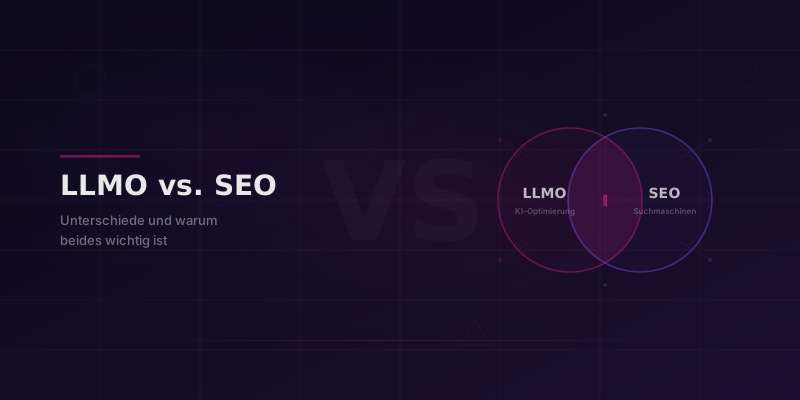
What is LLMO (Large Language Model Optimization)?
LLMO stands for Large Language Model Optimization: optimizing web content so that large language models such as ChatGPT, Claude, Perplexity or Google Gemini find it, process it and cite it as a trustworthy source. Unlike classic SEO, LLMO is not about reaching page one of Google. The goal is to be named as a reference in AI-generated answers when users ask questions.
The background: more and more people use AI assistants as their main research tool. Instead of running a Google search and clicking through ten blue links, they ask ChatGPT, Perplexity or Claude directly. These models write a single, connected answer and cite a few selected sources. Being visible in those citations is what LLMO is about.
LLMO takes into account how large language models process information. LLMs analyze text semantically, judge the authority of a source and check whether other trustworthy sources confirm the information. Search engine crawlers look mainly at keywords and backlinks; LLMs read the context, structure and credibility of a text at a deeper level. So LLM optimization means thinking beyond classic SEO tactics. The basics are covered in our article on GEO and Generative Engine Optimization.
LLMO vs SEO: the key differences side by side
LLMO and SEO share the same broad goal, more digital visibility, but they differ on several important points. The table sums up the core differences:
| Criterion | SEO | LLMO |
|---|---|---|
| Target platform | Google, Bing and other classic search engines | ChatGPT, Claude, Perplexity, Gemini and other LLMs |
| Goal | Top rankings in the organic search results (SERPs) | Being cited as a source in AI-generated answers |
| Content focus | Keyword-optimized copy, meta tags, internal linking | Semantically structured, verifiable content that is easy to quote |
| Success metric | Rankings, organic traffic, click-through rate (CTR) | AI visibility, mention frequency, citation share |
| Time frame | 3–6 months for measurable rankings | 4–8 weeks for first visibility in AI answers |
| Technical basis | Crawlability, page speed, Core Web Vitals, backlinks | Structured data, E-E-A-T signals, Schema.org, semantic clarity |
The table makes it clear: SEO and LLMO need different approaches. SEO leans heavily on technical factors and keyword strategy. LLMO focuses on content quality, credibility and presenting information in a machine-readable way. Both disciplines share one important thing, though: high-quality, well-structured content is the basis for success. A professional SEO audit can help you build the technical foundation for both.
Why your company needs both
In 2026, digital visibility runs on two tracks. Classic search engines like Google are still the most important traffic source for most websites. At the same time, AI-powered search is growing fast, and more and more people put their questions directly to assistants like ChatGPT, Gemini or Perplexity. If you rely on only one channel, you leave visibility on the table.
SEO brings direct traffic. When someone searches Google for your service and finds you on page one, they click your result and land on your website. This traffic is measurable, plannable and has a proven track record of converting well. That is why SEO stays an essential part of any digital strategy.
LLMO secures your AI visibility. When someone asks ChatGPT “Which SEO agency in Zurich would you recommend?”, LLMO decides whether your company is mentioned in the answer. Without LLMO you are invisible in this growing channel, even if you rank at the top of Google. Combining strong SEO content with LLMO gives you the widest reach.
Where LLMO and SEO overlap
The good news: many LLMO measures strengthen your SEO at the same time. Structured data improves how you appear in Google's search results. E-E-A-T signals raise your authority with Google and with LLMs. And high-quality, well-researched content ranks better and is used more often by AI systems as a source. How to plan both in one process is covered in the guide Combining SEO and GEO.
How to get started with LLMO
Getting started with LLMO does not have to be complicated. These five practical steps give you a solid foundation for your AI visibility:
1. Implement structured data
Schema.org markup is the direct line of communication between your website and AI systems. Implement at least the Organization, Person, Article and FAQPage schemas on your most important pages. Structured data helps LLMs understand the context of your content faster and more precisely. It states clearly who created the content, which company is behind it and which questions it answers. A thorough technical SEO audit uncovers gaps in your schema implementation.
2. Strengthen E-E-A-T signals
Experience, Expertise, Authoritativeness and Trustworthiness are the four pillars Google and LLMs both use to judge the quality of your content. Show concretely who is behind your content: author profiles with qualifications, references and proven experience. Link to specialist publications and show certifications or awards. The more transparent your expertise, the more likely AI systems are to rate you as a trustworthy source.
3. Create FAQ content
LLMs look for clear, precise answers to specific questions. FAQ sections on your pages provide exactly that. Phrase the questions the way your audience would ask them, and answer each in two or three sentences that make sense without the surrounding context. Add FAQPage schema so AI systems can read the question-and-answer structure. This pays into LLMO and SEO at once.
4. Cite authoritative sources
Link to reputable, recognized sources in your content, such as studies, official statistics or industry reports. LLMs also judge your content by whether you back up your claims. At the same time, create original content that others can cite: your own studies, unique data analyses or industry-specific insights. The more often your content serves as a reference, the stronger your LLMO profile becomes.
5. Update content regularly
Freshness is an important signal for LLMs. Outdated information is cited less often, because AI systems want to give users correct, current answers. Review your key content for accuracy at least once a quarter. Update statistics, add new developments and make sure all external links still work. An editorial calendar helps you run this process systematically.
Priorities: how to fit LLMO into your existing SEO and marketing
LLMO does not have to be a separate side project. It works best as an extension of your existing SEO and content processes. Since structured data, E-E-A-T signals and clearly structured content pay into Google rankings and AI visibility at the same time, you do not need two separate budgets. You add a few LLMO-specific steps to your editorial and optimization workflow.
In practice, for every new piece of content you check whether the main user questions are answered in answer blocks that make sense on their own, whether the right Schema.org markup is in place and whether authorship is visibly documented. In B2B marketing and sales, you bring in LLMO by covering exactly the questions your audience asks AI assistants along the customer journey, from first research to choosing a provider. That way LLMO becomes part of the content and SEO work you already do, not an extra silo. What this looks like in B2B sales is shown in the guide B2B lead generation via Google and AI search.
To start, a joint status check of SEO and LLMO makes sense. A free analysis of your current AI visibility shows which existing content can be made LLMO-ready with little effort and where new content pays off most. What LLMO costs and how to justify the budget is covered in the guide What does GEO cost in Switzerland?
Conclusion
LLMO and SEO pursue the same overall goal: making your company visible online. They do it on different platforms and with different methods. SEO brings you direct traffic via Google and other search engines, LLMO gives you visibility in the answers of ChatGPT, Claude, Perplexity and other AI assistants. As more and more users research with AI systems, you need both.
Investing in LLMO pays off especially now, because competition in this area is still low. Companies that act today build a lasting lead. Most LLMO measures also strengthen your SEO, so you benefit on both sides. Whether LLMO and GEO are a serious discipline, and which claims about them are backed by evidence, is examined in the article GEO: hype or real discipline?.
If you appear as a source in AI answers, you gain visibility and, with it, the trust of a new generation of searchers. LLMO is no longer optional. It is a strategic necessity.
Go deeper: learn how AI search systems select their sources and which E-E-A-T signals matter for AI search.
Want to know how well your company is optimized for LLMs? Learn more about our LLMO service or contact us directly for a free initial analysis of your AI visibility. You can work with us in English.