
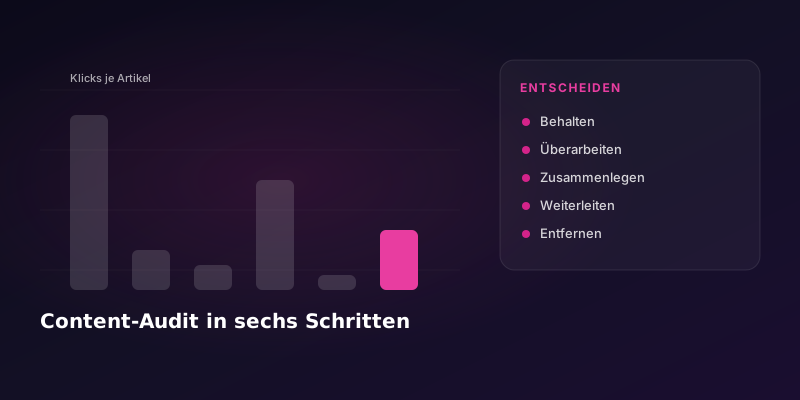
- A content audit is a systematic review of all your existing content, with the goal of deciding for each article: keep, rewrite, merge or remove.
- Blogs that bring no leads usually cover topics nobody searches for, have no link to what the company sells, or have several articles competing for the same search intent.
- If you remove an article that has backlinks, redirect it with a 301 to the closest matching content, never to the homepage by default.
- For AI citations, direct answers, tables and sourced numbers count for more than article length.
You have published dozens or hundreds of blog posts, but hardly any of them bring visits or leads. Writing more articles rarely fixes that. This guide shows you how to review what you already have and make a decision for every article. If you want to plan new content, the guide Content Strategy 2026 is the better starting point. We handle the implementation as part of our SEO content service.
Why many company blogs bring no leads
The most common reason is that the articles cover topics hardly anyone searches for. They come from internal ideas, news items or fixed slots in the editorial calendar, not from the questions customers ask.
The second reason is a missing link to what you sell. An article can bring visits and still no leads if it attracts readers who will never become customers, or if it does not show how your offer solves the question.
The third reason is several articles targeting the same search intent. They compete for the same queries, and Google shows one of them one day and another the next. This is called keyword cannibalization.
What is a content audit?
A content audit is a systematic review of all existing content on a website. For each article, you collect data such as clicks, impressions, backlinks and leads, and compare it with the search intent and your own offer. The result is one decision per article: keep, rewrite, merge or remove.
A content audit in six steps
- Inventory: List every article URL from your sitemap, a CMS export or a crawl, with title, publication date and category.
- Data per article: Add clicks, impressions and average position from Search Console for the last twelve months, visits and conversions from Analytics, and the number of referring domains from a backlink tool.
- Search intent per article: Note which question the article answers and which keyword it targets. Flag articles that share the same intent. How to work out the intent behind a question is covered in Reverse Search Intent Engineering.
- Scoring: Rate each article on demand, performance, relevance to your offer and freshness.
- Decision: Assign each article an action using the matrix below.
- Implementation and measurement: Set up redirects, rewrite and merge. After a few months, compare clicks and leads with the numbers from before the audit.
Keep, rewrite, merge or delete: the decision matrix
| Criterion | Decision |
|---|---|
| Brings clicks and fits your offer | Keep and keep it up to date |
| Has impressions, but a weak position or click-through rate | Rewrite: match the search intent more closely, sharpen the title and introduction |
| Topic has demand, content is outdated | Update it and change the "updated" date |
| Several articles for the same search intent | Merge into the strongest article and 301-redirect the others |
| No demand, but backlinks | 301-redirect to the closest matching article |
| No demand, no link to your offer, no backlinks | Remove |
Content pruning: when deleting does more than writing
Content pruning means deliberately removing or merging weak content. It pays off when many articles serve the same intent or cover topics with neither demand nor a link to your offer. Every one of these articles needs maintenance, and several weak articles on the same question take rankings away from one strong article.
Two rules apply. First: if an article has backlinks or still gets clicks, don't delete it without a replacement. Redirect it with a 301 to the closest related content. A blanket redirect to the homepage helps neither readers nor search engines. Second: when merging, move the best sections of all the articles into the strongest one and update the internal links.
Content that AI assistants cite
If you are revising content for ChatGPT and other AI assistants, you should know what the evidence says. In the GEO study from Princeton University, content with added statistics and quotations appeared much more often in generated answers, while classic keyword stuffing barely helped (Aggarwal et al., KDD 2024). In a controlled study by Ahrefs, structured data on its own brought no notable increase in AI citations (Ahrefs, May 2026).
For your audit, this means: for every article you keep, check whether each section starts with a direct answer, whether comparisons are shown as a table, whether numbers have a source and whether an "updated" date is visible. Which formats work well is covered in the guide Content Formats for AI Search. How we make content citable is shown on our Citation Engineering page.
Aligning shop guides with sales
A guides section in an online shop takes a lot of work and often contributes little measurable revenue. The reason is usually the same as with company blogs: the topics are not connected to the product range. So assign every guide to a product category and link from the text to the matching categories and products. Choose topics that prepare a purchase decision, such as comparisons or questions about sizes and materials.
Then measure how many purchases follow a visit to a guide. Page views alone tell you little about that. Guides that bring neither visits nor purchases get the same treatment as blog posts, using the same matrix. For online shops, we handle this as part of e-commerce SEO.
Updated: November 9, 2026 · Author: Baris Gündogdu, founder of SEOX GmbH
Sources: Aggarwal et al., GEO: Generative Engine Optimization, KDD 2024, arxiv.org; Ahrefs, We Tracked 1,885 Pages Adding Schema. AI Citations Barely Moved., May 11, 2026, ahrefs.com.