
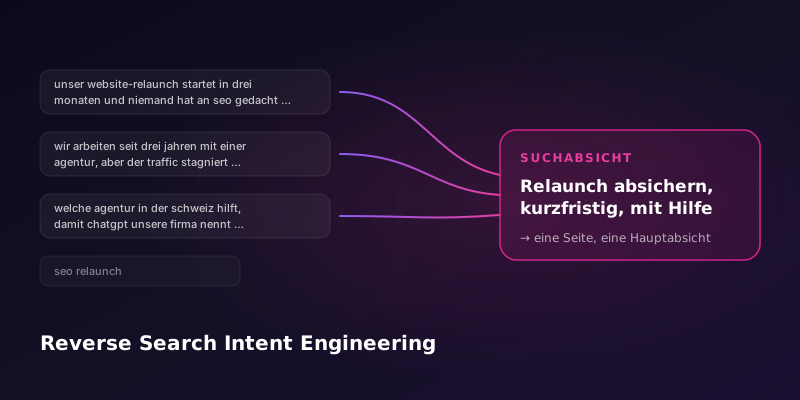
- Reverse search intent engineering uses a website's own search data to work out which intentions and questions sit behind the searches, then aligns pages with them.
- Search Console now shows many queries phrased like chat prompts. For seox.ch, 16 months of data contained 1,725 queries with eight or more words and over 83,000 impressions, but only one click.
- A keyword tells you the topic. A fully written prompt also tells you the person's situation, time pressure and specific concern.
- The method is neither a keyword tool nor guesswork about prompts. It works with queries that demonstrably exist.
What is reverse search intent engineering?
Reverse search intent engineering is a method that uses a website's existing search data to work out which intentions and questions sit behind the searches, and then aligns content with them. SEOX coined the term to give this process a clear name. "Reverse" means we do not start with a list of terms we consider important. We start with what people actually typed and work back from there to the intent.
The main data source is the search queries in Google Search Console. The second source is questions from sales and support, meaning what prospects want to know on the phone or by email. Together they show which questions your customers ask a search engine and an AI assistant such as ChatGPT, Perplexity or Gemini. How we then capture and measure these questions systematically is described on our prompt mapping service page.
There is nothing secret about it. The process is open, and any team with access to its Search Console can follow it. What has changed is how much the data reveals about intent, now that people type full sentences instead of two words.
Why keywords alone are no longer enough
In a classic search box, people type short terms such as "seo relaunch". In a chat with an AI, they describe their situation: which industry they work in, how much time is left, what they are worried about and what they have already tried. The intent is often the same; the language is different.
For content planning, that makes a big difference. The keyword tells you what to write about. The prompt tells you which question your page has to answer to fit this person.
| Keyword | Prompt-style query | |
|---|---|---|
| Length | One to three words | One or more sentences |
| Content | Topic | Topic, situation, time frame, concern, help wanted |
| What you learn from it | What a page should be about | Which question the page has to answer, and for whom |
| Example | seo relaunch | "our website relaunch starts in three months and so far nobody has thought about seo …" |
Long prompt-style questions now appear in Search Console
Google does not report appearances in AI features such as AI Overviews and AI Mode separately in Search Console. According to Google, they count as normal search traffic in the Performance report, search type "Web" (Google Search Central). If you sort your queries by length, you will see full sentences more and more often.
We analyzed this for seox.ch ourselves (Google Search Console, domain property seox.ch, July 7, 2025 to November 5, 2026, analyzed on November 6, 2026):
- In this period, Search Console recorded 15,059 different queries in total.
- 1,725 of them have eight or more words. Together they account for 83,207 impressions and exactly one click.
- The median length of these queries is 12 words. 260 queries have 30 or more words; the longest has 154.
- The median position of these long queries is 5.3.
So Google mostly shows seox.ch on the first page for these fully written questions, yet almost nobody clicks. The demand is visible in the data, but it is apparently answered somewhere else, for example directly in an AI answer. Search Console does not, however, show where each individual query came from.
A worked example from our data
One of these queries (anonymized, shortened and translated from German) appeared several hundred times over the 16 months:
"our website relaunch starts in three months and so far nobody has thought about seo. i need a service provider at short notice to secure the migration: redirects, indexing …"
The matching keyword for the same topic is "seo relaunch". The prompt reveals much more: the project is already under way, time is short, the person is looking for a service provider, and the concern is redirects and indexing. A page that only explains in general terms what a relaunch is does not answer this question. A page that shows how to secure a migration that is already running, at short notice, does.
From search query to search intent: the method in five steps
The process has five steps. Step 1: collect the data, meaning queries from Search Console plus questions from sales and support. Step 2: group the queries by intent, not by wording, because ten different phrasings can ask the same question. Step 3: assign each intent to exactly one page. Step 4: where no suitable page exists, you have found a gap, and we close it. Step 5: measure whether the page appears for these questions in Google and in AI answers.
Four types of intent
For the assignment, we distinguish four types of intent:
- Brand: the person is looking for your company specifically.
- Purchase-ready: the person is looking for a provider or solution and wants to decide soon.
- Informational: the person wants to understand something before acting.
- Questions from AI search: fully written questions with a situation and conditions, the way people type them into a chat.
One page, one main intent
Every page gets one main intent. A page that tries to sell, explain and compare at the same time answers none of these questions really well. For Google, this often means several of your own pages compete for the same query. For AI assistants, it means the page has no clear section they can take over as an answer. How AI systems choose their sources is covered in our guide on AI search systems and source selection.
What changes on your pages
Purchase-ready questions belong on the service's landing page. That page must contain the answer someone needs before getting in touch: what exactly is done, who it suits and what the process looks like.
Informational questions get their own guides. Someone who wants to understand how something works is not yet ready for an offer and will quickly leave a sales page.
Existing pages get targeted additions instead of simply getting longer. If the data shows that people keep asking about the time frame for a service, the page needs a clear section on it. Which formats AI assistants can take over easily, such as direct answers, tables and FAQs, is covered in the article on content formats for AI search.
Example: a relaunch built on search intent instead of a 1:1 copy
A website relaunch shows the difference most clearly. Often, all the old pages are rebuilt in the new design with the same content and the same structure. That carries over every old weakness too: pages with no clear intent, duplicate topics, content nobody searches for.
A better approach is to clarify for each page before the relaunch which Search Console queries and which AI questions it currently appears for, and what intent lies behind them. Then you decide page by page: keep, merge, redesign or redirect. The result is fewer, better-fitting landing pages. The technical side still matters: every old URL needs a target, and every redirect is tested. How we support this is described on the page relaunch built on search intent instead of a 1:1 copy. What to check before, during and after go-live is listed in the website relaunch checklist, and the general technical checkpoints are in the technical SEO checklist.
We have supported over 50 relaunches, including the Swiss local search platforms local.ch and search.ch. For The Gentlemen's Clinic, the old pages and URLs were moved to a new design with new content and a structure that AI systems can read more easily. Through the relaunch and ongoing support, the SISTRIX Visibility Index for Switzerland rose from 0.12 (January 27, 2025) to 1.12 (November 2, 2026).
What reverse search intent engineering is not
It is not guessing prompts. If you sit at your desk and imagine what customers might ask ChatGPT, you end up with your own assumptions. The method starts with queries that are documented in the data.
Nor is it a keyword list from a tool. Search volume tools show how often a term is searched. Long, one-off sentences usually do not appear there at all. For classic research into terms and volumes, keyword research remains useful; the two approaches complement each other.
And it does not replace measurement. Reverse search intent engineering tells you which questions you should answer. Whether your brand then appears in the answers of ChatGPT, Perplexity and Gemini is measured separately. Our guide on measuring AI visibility explains how.
How to tell whether the approach is worth it for you
The approach is worth it if your website has several months of Search Console history. Without data, there is nothing to trace back. It pays off especially if your offer needs explaining and customers have many questions before they get in touch. It is also worth it if, when you sort your queries by length, you find many full sentences that bring impressions but hardly any clicks. That is exactly where demand sits that none of your pages answers properly today.
As of November 6, 2026 · Author: Baris Gündogdu, founder of SEOX GmbH
Sources: Our own analysis of Google Search Console, domain property seox.ch, period July 7, 2025 to November 5, 2026, retrieved on November 6, 2026; Google Search Central, AI Features and Your Website, developers.google.com; SISTRIX Visibility Index Switzerland for gentlemensclinic.ch, January 27, 2025 to November 2, 2026.