
What is schema markup?
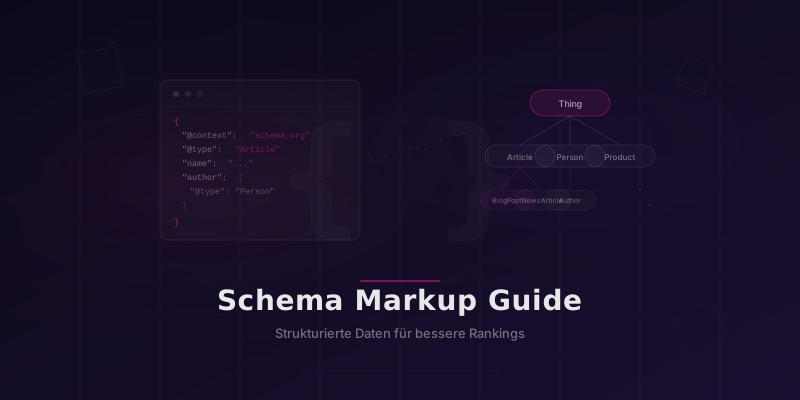
Schema markup, also known as structured data, is a standardized vocabulary defined by schema.org that helps search engines understand the content of a web page. It is additional code embedded in a page's HTML that provides machine-readable information about people, products, articles, events, FAQs and much more.
The idea is simple: people grasp the context of a web page intuitively, but search engines need clear signals to classify content correctly. Schema markup closes that gap. It tells Google, Bing and AI systems in a standardized language what is on a page: a blog article, a product with a price, an FAQ page or a local business with opening hours.
In practice, schema markup is embedded in the HTML as JSON-LD (JavaScript Object Notation for Linked Data). It is separate from the visible page content and doesn't affect the design of the page. It works in the background and communicates directly with search engine crawlers and algorithms.
Why does structured data matter?
Structured data is far more than a technical detail. It is a strategic SEO tool with a measurable impact on visibility in search results. The main benefits at a glance:
- Rich snippets in search results: Star ratings, prices, FAQ dropdowns, event dates and more appear directly in Google's results. That makes your result stand out visually from the competition.
- Higher click-through rates (CTR): Studies show that rich snippets can increase the click-through rate by 20-30%. More visual space in the SERPs means more attention and more clicks.
- Easier to understand for Google AND AI systems: Google uses structured data to populate the Knowledge Graph and generate featured snippets. AI search engines such as ChatGPT and Perplexity also draw on this information.
- A foundation for GEO: AI search engines use schema markup as a trust signal. If you implement structured data correctly, you raise the chance of being cited as a source in AI-generated answers.
The most important schema types for businesses
Schema.org includes hundreds of types, but not all of them are relevant for every business. The table below shows the eight schema types that matter for most companies:
| Schema type | Use case | Rich snippet effect |
|---|---|---|
| Organization | Company page | Knowledge Panel, logo |
| LocalBusiness | Local businesses | Maps integration, opening hours |
| Article | Blog posts | Article preview, date, author |
| FAQPage | FAQ sections | FAQ dropdowns in Google |
| HowTo | Instructions | Step-by-step in search |
| Product | Shop/products | Price, availability, rating |
| BreadcrumbList | All pages | Breadcrumb path in Google |
| Person | Author pages | Author info, E-E-A-T signal |
Which schema types are right for you depends on your business model and your page types. A local restaurant benefits from LocalBusiness and FAQPage, an online shop from Product and BreadcrumbList, a blog from Article and Person.
JSON-LD: the preferred format
Google explicitly recommends JSON-LD (JavaScript Object Notation for Linked Data) as the format for structured data. There are alternatives such as Microdata and RDFa, but JSON-LD has become the standard, for good reasons.
JSON-LD is embedded as a <script> block in the page's <head> or <body>. The key advantage: it is completely separate from the visible HTML. You don't have to change existing HTML elements or add extra attributes, and you don't risk display problems. JSON-LD is easy to implement, easy to maintain and can be updated without developer skills.
Practical example: Organization schema
The Organization schema is one of the most basic and most effective schemas. It tells Google who your company is and provides the basis for the Knowledge Panel in search results. A complete Organization schema contains these core fields:
- name: The official company name
- url: The main URL of your website
- logo: The URL of your company logo
- contactPoint: Contact information with phone number, email and contact type
- sameAs: Links to all official social media profiles (LinkedIn, Twitter, Instagram etc.)
- address: The full company address with street, postal code, city and country
With the sameAs field you connect your website to your social media profiles. Google uses this information to build a complete picture of your company and fill the Knowledge Panel with relevant links.
Implementation tip
Place the Organization schema on every page of your website, not only on the homepage. That way Google gets the context of which company the content belongs to on every page. This strengthens E-E-A-T signals across the entire domain.
Practical example: FAQPage schema
The FAQPage schema is especially valuable because it leads directly to visible FAQ dropdowns in Google's search results. These dropdowns take up extra space in the SERPs and raise the click-through rate noticeably.
The structure is clear: the FAQPage schema contains a mainEntity array with individual question-answer pairs. Each question is defined as a Question with a name field, each answer as an acceptedAnswer with a text field. One point matters here: the questions and answers in the schema must match the visible FAQ content on the page exactly. Google penalizes discrepancies.
We recommend 3-5 FAQ entries per page. Too many questions dilute the focus and may be ignored by Google. Choose the questions your audience actually asks and that offer real value.
Schema markup and GEO
Structured data plays a particularly important role in Generative Engine Optimization (GEO). AI search engines such as ChatGPT, Perplexity and Google AI Overviews use schema markup as an additional source of information to understand and evaluate content.
The connection makes sense: AI systems have to decide in fractions of a second which sources are trustworthy and relevant. Schema markup provides exactly the signals that make this decision easier. Three aspects are especially relevant:
- Organization and Person schemas strengthen E-E-A-T signals: AI systems can read directly who the author is, what qualifications they have and which company they work for. That increases trustworthiness.
- Article schemas provide context: Publication date, category, word count and topic help AI systems judge how current and relevant the content is.
- FAQ schemas provide clear answers: The structured question-answer pairs come in a format that LLMs can easily pick up and include in generated answers.
If you implement schema markup consistently, you improve your chances both in classic search results and in AI-generated answers. It is an investment that pays off on both channels. The easiest way is to plan schema directly into the templates during a website relaunch.
Avoid common mistakes
Schema markup isn't technically complex, but there are typical mistakes that cancel out its effect or can even lead to penalties:
- Schema markup that doesn't match the visible content: Google expects structured data to reflect the content actually visible on the page. If your schema promotes products that don't appear on the page, you risk a manual action.
- Missing required fields: Every schema type has certain required fields. An Article without a
headlineor a Product without anamewon't be processed by Google. The Rich Results Test reliably shows missing fields. - Outdated Microdata instead of JSON-LD: Microdata is still valid, but much harder to maintain and more error-prone. Switching to JSON-LD is always worth it.
- Never validating schema markup: Every implementation should be validated with Google's Rich Results Test. Syntax errors in JSON-LD are common and cause the entire markup to be ignored.
- Too many irrelevant schema types: Use markup only for content that is actually on the page. Irrelevant schemas confuse Google and dilute the signals.
Tools for testing
Validating your schema markup is an essential step. You should know and regularly use these three tools:
- Google Rich Results Test: Checks whether your markup qualifies for rich snippets. Shows errors, warnings and a preview of the possible rich result.
- Schema Markup Validator (schema.org): Validates the technical correctness of your JSON-LD against the official schema.org specification. Ideal for a detailed check.
- Google Search Console (Enhancements section): Shows in the live environment which schema types Google has detected on your website and whether there are problems. The best indicator of the actual status.
Summary: schema markup as a strategic advantage
Schema markup is not an optional nice-to-have but a strategic advantage for every website that wants to be visible in Google and AI search engines. Implementation is technically manageable, yet the effect is considerable: rich snippets, higher click-through rates, better AI visibility and stronger E-E-A-T signals.
Our advice: start with the three most important schema types (Organization, BreadcrumbList, Article) and add FAQPage, Person and industry-specific types step by step. Validate every implementation with the Rich Results Test and monitor the results in Google Search Console.
Structured data is the language you use to talk directly to search engines and AI systems. If you speak it, you are heard. If you ignore it, you stay invisible.
Also read our article on llms.txt and structured data for AI search and find out which content formats work best for AI search engines.
Want schema markup implemented professionally on your website? Start a free SEO analysis now and find out which structured data you are still missing and what potential it can open up.