
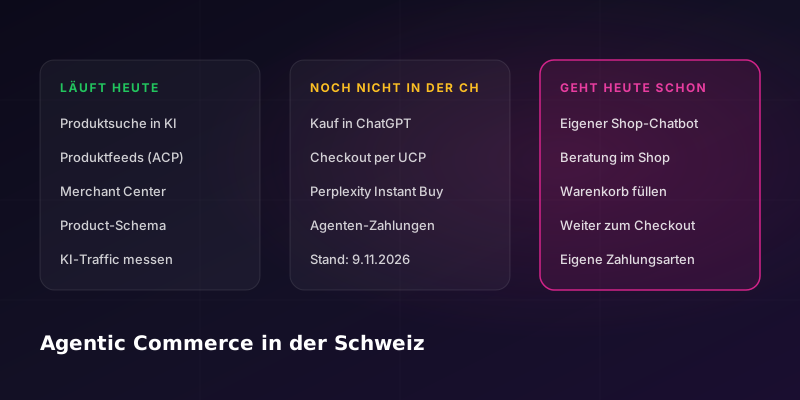
- Product discovery in AI assistants works: ChatGPT, Google AI Mode and Gemini show products from merchant feeds.
- Buying directly in the chat is not available to customers in Switzerland as of November 9, 2026. ChatGPT, Google and Perplexity offer it only in the US and partly in Canada and Australia.
- Whether an assistant shows your products depends mainly on your product data: schema, Merchant Center, feed, prices and stock.
- Your own shop chatbot that gives advice and takes customers through to checkout already works today, independent of the platforms.
Agentic commerce is one of the loudest buzzwords in online retail in 2026. This guide separates what actually works for Swiss online shops today, what has been announced and what only runs in the US. Every statement about a platform links to the provider's own source. Because things change constantly, we update the article every quarter. If you want support for your shop, you can find our offer on the agentic commerce agency page.
What is agentic commerce?
Agentic commerce means purchases where an AI agent searches for, compares and buys products on behalf of a person. The person sets the goal, for example “hiking boots, size 43, under CHF 200, delivered by Friday”, and the agent handles the steps up to the order, with that person's permission.
You can distinguish three stages. In conversational commerce, a chatbot answers questions, and the purchase happens in the shop as usual. In AI product discovery, an assistant such as ChatGPT puts together products and links to the merchants. Only with a purchase by the agent does the assistant complete the order itself, including payment. In the narrow sense, agentic commerce means this third stage. It is part of what is called the agentic web: websites that agents read and also operate.
Agentic commerce in Switzerland: the state of play in November 2026
As of November 9, 2026, customers in Switzerland cannot buy directly in the chat on any of the major platforms. Product discovery works, but completing a purchase inside the assistant is limited to the US and a few other countries. The table shows the status for each platform, with its source.
| Platform | Buying in the chat | For customers in Switzerland | Source |
|---|---|---|---|
| ChatGPT (OpenAI) | No. Since March 24, 2026, purchases happen on the merchant's site. Shopping is “currently live for ChatGPT users in the U.S.” | Not available | chatgpt.com/merchants |
| Google AI Mode and Gemini | Yes, through the Universal Commerce Protocol, for selected merchants in the US, Canada (since November 4, 2026) and Australia | Not available | Google Merchant Center Help |
| Perplexity | Yes, “Instant Buy” or “Buy with PayPal” at participating merchants, rolling out to users in the US | Not available | PayPal |
| Microsoft Copilot (via Shopify) | With direct checkout, according to Shopify | No information found for Switzerland | Shopify Help |
| Shopify Agentic Storefronts | Channels: ChatGPT, Google AI Mode and Gemini, Copilot and Meta. Active by default for eligible shops | ChatGPT channel only if the shop sells to customers in the US. The shop itself may be based outside the US | Shopify Help |
For a Swiss online shop, this means: if you only sell within Switzerland, you cannot sell inside the chat today. You can make sure your products show up correctly in the answers, though, and prepare your shop so that agent purchases can be added without a rebuild as soon as a platform opens them up for Switzerland.
ChatGPT shopping: why OpenAI stepped back from buying in the chat
ChatGPT shows products from merchant feeds, but the purchase happens on the merchant's website. On September 29, 2025, OpenAI had launched buying directly in the chat, called “Instant Checkout”, together with the Agentic Commerce Protocol (ACP), which OpenAI developed with Stripe. It was available to people in the US buying from US merchants.
On March 24, 2026, OpenAI changed course. The announcement says: “We've found that the initial version of Instant Checkout did not offer the level of flexibility that we aspire to provide, so we're allowing merchants to use their own checkout experiences while we focus our efforts on product discovery.” Since then, merchants mainly use ACP to share their product feeds and promotions.
According to the merchant page, ChatGPT sends purchases to the merchant's website or app by default, with no fees on these purchases. Shopping is listed there as live for users in the US, with more regions to follow “over time”. The feed specification requires nine mandatory fields per product or variant, including description, brand, seller, image, availability and price. A checkout needs a separately approved integration.
If you want paid visibility in ChatGPT, you can run ads in ChatGPT. That is a separate channel and does not replace your product data.
Universal Commerce Protocol: Google's route to checkout in AI Mode and Gemini
Google is betting on buying inside the assistant. The Universal Commerce Protocol (UCP) is an open standard that Google launched in 2026 with partners from retail and payments. According to Google, UCP covers the entire purchase, “from discovery and buying to post-purchase support”.
According to the Merchant Center Help, checkout through UCP is only available for eligible products in the US, Canada and Australia, and only for “select merchants”. Participation runs through an early access form. Requirements are a Merchant Center account, the product attribute native_commerce(checkout_eligibility) and an account in the Google Pay & Wallet Console. On November 4, 2026, Google extended checkout to Canada and announced a simplified UCP integration directly in Merchant Center “starting next year”.
There is no date yet for Swiss shops. What you can do today is in Google's own answer: Merchant Center remains the hub for product data, and the best preparation is data that is as complete and current as possible. Our article on Google I/O 2026 and Universal Cart covers the background to Google's shopping plans from May.
ACP, UCP, AP2 and MCP: which protocol does what
Four protocols come up in almost every text about agentic commerce. They only partly compete, because they cover different parts of a purchase: product data, completing the purchase, payment, and access by AI applications to third-party systems.
| Protocol | Publisher | Purpose | What the merchant does |
|---|---|---|---|
| Agentic Commerce Protocol (ACP) | OpenAI with Stripe, since September 29, 2025 | Product feeds and promotions for ChatGPT, checkout optional | Supply a feed following the OpenAI specification |
| Universal Commerce Protocol (UCP) | Google with partners, 2026 | Discovery, purchase and post-purchase in AI Mode and Gemini | Maintain Merchant Center, apply for early access (US, Canada, Australia) |
| Agent Payments Protocol (AP2) | Google, announced September 16, 2025 with more than 60 organizations | Process payments triggered by an agent securely | Nothing directly today; payment providers handle this |
| Model Context Protocol (MCP) | Open standard | Connect AI applications to external systems, such as a product catalog | Optionally offer an MCP endpoint for your catalog or for advice |
According to Google Cloud, AP2 can be used as an extension of the Agent2Agent protocol (A2A) and of MCP. The Model Context Protocol describes itself as an “open-source standard for connecting AI applications to external systems”. A2A and MCP also matter for companies without a shop: they let them become findable and reachable for AI agents. The page on agent readiness with A2A and MCP and the guide to a website for AI agents explain how.
Payments by AI agents: Visa, Mastercard, Stripe, PayPal, Klarna
The big payment providers are building agent payments, mostly as pilots or in the US first. As of November 2026, none of this is generally available to book for Swiss shops.
- Visa reported live agent purchases in Europe on July 2, 2026, with more than 30 European card issuers and merchants such as lastminute.com and Frasers. The list also includes Swiss issuers: Cornèrcard, Swisscard and Viseca.
- Mastercard and Santander carried out the first payment by an AI agent in Europe on March 2, 2026. According to the press release, this is explicitly not a commercial launch yet.
- Stripe offers its Agentic Commerce Suite in the US, Canada and “select European countries”, according to its documentation. The page does not say whether Switzerland is included.
- PayPal processes “Instant Buy” and “Buy with PayPal” in Perplexity, rolling out to users in the US, according to PayPal.
- Klarna has supported the Universal Commerce Protocol since February 2, 2026 and reaches agent checkouts through Stripe, initially for US merchants according to its announcement of March 3, 2026.
- TWINT (the Swiss mobile payment app): up to November 9, 2026, we found no announcement from TWINT about payments by AI agents.
How Swiss customers use AI when shopping
The demand is there; trust in letting AI make the purchase is not. In a survey commissioned by Visa (Management Tools Research, 1,260 people aged 18 to 65, end of July to mid-August 2026), 70 percent said they had used AI to prepare purchases. Only 17 percent could imagine letting an AI make purchases fully on its own, including payment. A good two thirds want to trigger every payment themselves.
On the merchant side, the 2026 online retailer survey by FHNW (University of Applied Sciences Northwestern Switzerland), with 473 online shop operators, shows a similar picture: 70 to 75 percent expect product search, price comparison and recommendations to be driven by AI in the future. 51 percent consider Generative Engine Optimization at least somewhat relevant. But only 2 percent have a strategy for AI or agentic commerce and are putting it into practice.
For shops, this means: in 2026, the lever is product discovery. If you show up correctly there, you get recommended, even if the purchase still happens in your own shop.
What your shop should prepare for AI shopping agents now: checklist
These points make your shop readable for AI assistants and ready for agent purchases later. The first six already affect product discovery today.
- Complete product schema: name, brand, GTIN, price, currency, availability, reviews and variants on every product page. Our guide to product schema shows what this looks like.
- A clean Google Merchant Center: no disapproved items, current feeds, correct shipping settings. Google itself calls this the best preparation for UCP.
- A feed following the OpenAI specification: prepare the nine mandatory fields per variant, even though ChatGPT shopping is not live in Switzerland yet.
- Real-time prices and stock: an agent that recommends a sold-out item loses the user's trust, and your feed loses the platform's trust.
- Machine-readable shipping and return policies: as structured data and clearly worded on the website, instead of hidden in a PDF of your terms and conditions.
- Allow AI crawlers: check in your robots.txt whether OAI-SearchBot, GPTBot, PerplexityBot and Google-Extended are set the way you want.
- Measure AI traffic: set up a separate channel in GA4 for visits from ChatGPT, Perplexity, Gemini and Copilot, and check regularly whether the assistants mention your products. The guide on measuring AI visibility shows how.
- Check Shopify Agentic Storefronts: if your shop runs on Shopify, look in the admin to see which channels are active and which products are eligible for the Shopify Catalog.
- Ask your payment providers: Stripe, PayPal, Klarna or your Swiss provider: what is planned for agent payments, and from when for Swiss merchants?
- Use the US as a test market: if you already sell to the US, you can test ChatGPT shopping and the Shopify channel there today and gain experience for the launch in Switzerland.
For Google, e-commerce SEO remains the foundation. Agentic commerce builds on it, but does not replace it.
Checkout in your own shop chatbot: the option that works today
You can already offer buying in a chat today, just not in ChatGPT: on your own website. A shop chatbot runs in your shop, knows your product range and takes the customer from the first sentence through to checkout.
- Question: the customer describes what she is looking for in her own words.
- Advice: the chatbot asks follow-up questions, compares suitable products from your catalog and explains the differences.
- Cart: it adds the chosen products, with size and variant, to the cart.
- Checkout: it takes the customer to your existing checkout. Your payment methods and your terms apply there.
This requires access to catalog, stock and cart through your shop system's API, clear rules for what the chatbot may say, and tracking of how many conversations lead to a purchase. You don't depend on any platform. The article on AI chatbots for businesses covers general use cases for chatbots, and the AI chatbot page covers chatbots for advice and support. We build the shop chatbot with checkout as part of our service to prepare your shop for AI agents.
Sources, all accessed on November 9, 2026: OpenAI, Buy it in ChatGPT, September 29, 2025; OpenAI, Powering Product Discovery in ChatGPT, March 24, 2026; chatgpt.com/merchants; OpenAI Developers, Products Feed Specification; Google Merchant Center Help, About the Universal Commerce Protocol; Google Canada Blog, November 4, 2026; Google Cloud Blog, Announcing AP2, September 16, 2025; modelcontextprotocol.io; Shopify Help Center, Agentic storefronts; PayPal, How PayPal powers AI shopping; Stripe Docs, Sell products through agents; Visa, press release of July 2, 2026; Mastercard, press release of March 2, 2026; Klarna, announcements of February 2, 2026 and March 3, 2026; watson.ch, October 15, 2026 (Visa survey, in German); Netzwoche, September 15, 2026 (FHNW online retailer survey 2026, in German). We found no TWINT announcement on AI agents on twint.ch or in media reports.