
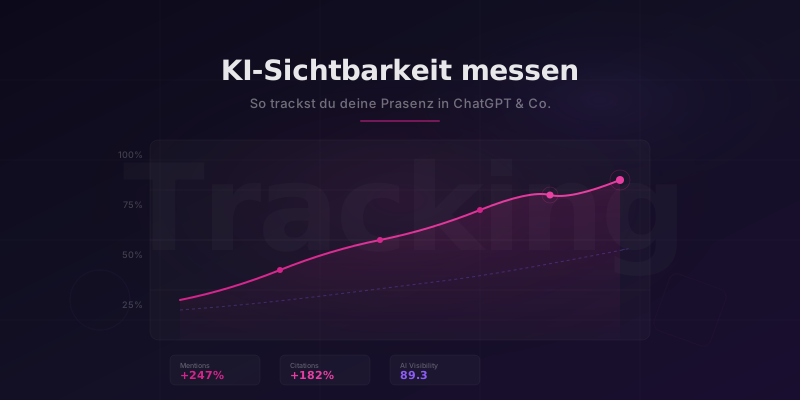
Why AI visibility is the new metric
Search is changing at its core. More and more people use ChatGPT, Perplexity or Google AI Overviews to find information. For businesses, this means a completely new kind of visibility next to the classic Google ranking: AI visibility, meaning how often AI assistants mention and cite your brand.
With Google, Search Console gives you precise data on impressions and clicks. For AI search engines, there is no standardized interface (yet). That is the main limit of AI visibility tracking, but it does not mean you have to work blind. With the right tools and methods, you can measure your presence in AI answers systematically and improve it. Which questions you should measure in the first place can be derived from your Search Console data. Our guide to reverse search intent engineering explains how.
The key metrics for AI visibility tracking
Before you start measuring, you need clear KPIs. These four metrics are the basis of your AI monitoring:
- Citation share - How often is your company cited as a source compared to your competitors? This is the most important KPI for AI visibility.
- Mention frequency - How often does your brand name or domain appear in AI answers? Our guide to digital PR for AI visibility shows how to build mentions deliberately.
- Source position - Where do you appear in the order of sources? Source 1 carries much more weight than source 5.
- Sentiment score - How do AI answers portray your company? Positive, neutral or negative?
Tools compared: how to track AI visibility
The market for AI search tracking tools is growing fast. Here is an overview of the main options:
| Tool | Focus | What sets it apart |
|---|---|---|
| Otterly.AI | ChatGPT, Perplexity, AI Overviews | Automated queries with keyword tracking |
| Profound | LLM visibility | Competitor comparison and trend analysis |
| aimaco.ai | AI visibility index | Swiss tool with a comprehensive dashboard |
| Manual monitoring | All platforms | Free, but time-consuming |
Step by step: how to measure AI visibility
Step 1: Define the relevant questions
Create a list of 20–50 questions your audience typically asks AI search engines. Use customer conversations, support requests and keyword research as sources. Examples: “Which SEO agency in Zurich is the best?” or “How do I optimize my website for ChatGPT?”
Step 2: Query systematically
Enter these questions in ChatGPT, Perplexity and Google (for AI Overviews). For each answer, record: Is your company mentioned? In which position? How is it portrayed? Use the same template every time so your records stay comparable.
Step 3: Include your competitors
Repeat the process with a focus on your main competitors. Compare: Who is cited more often? Who appears in the more prominent positions? This competitive intelligence shows you where you stand and where you have ground to make up.
Step 4: Repeat regularly
AI answers keep changing as new training data and sources are added. Set up a weekly or monthly tracking rhythm so you can spot trends. Automated tools take this work off your hands.
From measurement to optimization
Collecting data is only the first step. What matters is drawing the right actions from it. If your company is missing from AI answers, check your E-E-A-T signals first. AI systems prefer sources with clear authority and trustworthiness. Our guide to winning new customers through ChatGPT describes how to connect your measurements with where your inquiries come from.
Optimize your content for GEO (generative engine optimization) by using structured data, providing quotable facts and communicating your expertise clearly. Our guide What is GEO? covers the complete strategy.
If you don't measure your AI visibility, you are optimizing blind. The good news: with the right KPIs and tools, you gain a clear competitive advantage.
Want to know how visible your company is in AI search engines? Our GEO/LLMO audit gives you a complete analysis with recommendations. As an SEO & GEO agency, we help you increase your AI visibility systematically.
Also read how AI search engines select their sources and which GEO trends in 2026 will shape AI visibility. If your measurements reveal gaps, our GEO optimization in 7 steps helps you build your visibility in ChatGPT, Perplexity and AI Overviews.