
- Since December 2022, Google has automatically neutralized unnatural links with its SpamBrain system; these links lose their effect.
- Whether there is a penalty is shown in the “Manual actions” report in Search Console. If the report is empty, there is no manual action.
- According to Google, most websites do not need the disavow tool. It makes sense when many spam links have triggered a manual action or are likely to trigger one.
- After the review, what counts is building authority cleanly through mentions and links from relevant sources.
Years ago, someone bought links for your website, or a former agency collected entries in directories and article networks. Now you are wondering whether this legacy is hurting you. This guide explains plainly when such links are a problem, how to check whether Google has taken action against your site, and when a cleanup is worth it. For rebuilding afterwards, we offer link building without spam risk.
Do bought links still cause harm today?
Mostly they lose their effect rather than harming the website directly. In its spam policies, Google explicitly counts bought links, articles with paid links and optimized anchor texts, and links from low-quality directories as link spam (Google Search Central). Since the link spam update of December 2022, Google has used its SpamBrain system to neutralize the effect of unnatural links. Google writes that rankings may change because the value of these links is lost (Google Search Central Blog, December 2022).
This means: if your website used to benefit from bought links, that advantage may be gone without you noticing. A direct penalty is something else. Google calls it a manual action, and you can check for it clearly.
Check first: is there a manual action?
Google imposes a manual action when a human reviewer finds that pages violate the spam policies. You see it in Google Search Console in the “Manual actions” report and receive a message in the messages section. If the report is empty, there is no manual action. Once you have fixed the issue, you submit a reconsideration request in the same report (Search Console Help).
If the report is empty and your visibility has dropped anyway, the cause is probably somewhere else, for example a core update, a technical change or your competitors. The order in which to check is described in our guide traffic drop: finding the causes.
How to recognize toxic backlinks
Toxic backlinks are links that count as manipulation under Google's spam policies. The following characteristics help you classify them:
| Characteristic | Sign of risk | What to do |
|---|---|---|
| Articles in networks covering random topics, with keyword anchor texts | Google names paid posts with optimized anchor texts as link spam | Record them, ask the site owner to remove them |
| Entries in low-quality directories or bookmark sites | Explicitly named by Google as an example of link spam | Usually already devalued; only request removal if there are many |
| Many links with exactly the same money keyword as anchor text | Pattern of an artificially built profile | Analyze the distribution of anchor texts |
| Sitewide links in footers or widgets of other websites | Named in the spam policies | Request removal or a nofollow attribute |
| Large-scale link exchanges or partner pages created only for linking | Excessive link exchange counts as link spam | Reduce exchange links |
Values such as a “toxic score” in backlink tools are the vendors' estimates, not Google's view. They help with sorting, but they do not replace looking at each referring page.
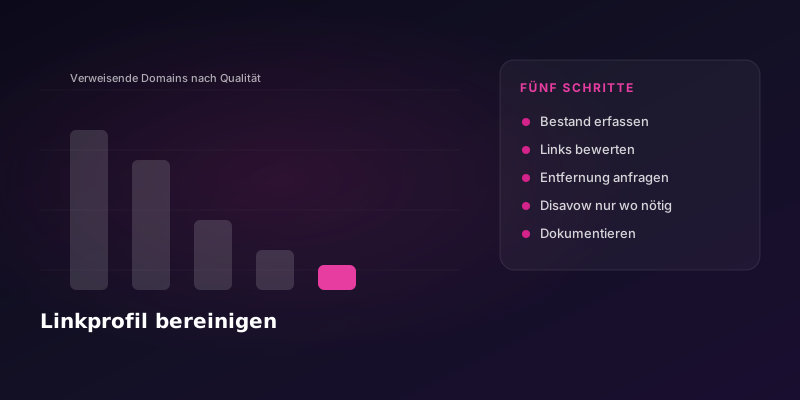
Cleaning up your link profile in five steps
- Take stock: export the links from the “Links” report in Search Console and add the data from a backlink tool.
- Assess the links: check the referring domains against the characteristics above and flag the ones that are clearly bought or artificial.
- Request removal: ask the site owners to remove the links or mark them as nofollow or sponsored, and keep a record of their replies.
- Disavow only where necessary: disavow links only if the conditions Google names are met (see below).
- Document: record which links you handled and how. If there is a manual action, you need this documentation for your reconsideration request.
When the disavow tool makes sense and when it doesn't
With the disavow tool, you tell Google that certain links should not be taken into account when assessing your website. According to Google, in most cases it can judge without extra help which links are trustworthy, so most websites do not need the tool. Google says it makes sense if a considerable number of spammy, artificial or low-quality links point to your website and these links have triggered a manual action or are likely to trigger one (Search Console Help).
If there is no manual action and you only have a few questionable links, the effort is usually not worth it. A disavow file also applies to every link listed in it: if you add whole domains too generously, you may also give up links that were helping you.
After the cleanup: building authority cleanly
Cleanly built authority comes from mentions and links that the source creates out of its own interest: expert articles in industry media, your own studies and data, interviews, association and partner pages. Under Google's policies, paid placements are allowed if the link is marked with rel="sponsored" or rel="nofollow" (Google Search Central). How to build such mentions in a targeted way is described in our guide digital PR for AI visibility. For us, review and rebuilding go together: a backlink audit as part of off-page SEO comes first, then the rebuilding. The glossary explains the basics of backlinks, off-page SEO and link building.
Link profile and AI visibility
For visibility in AI answers, links count for less than is often assumed. In an analysis of 75,000 brands, Ahrefs found that mentions of a brand on the web are much more strongly related to its visibility in ChatGPT, AI Mode and AI Overviews than the number of its backlinks (Ahrefs, December 2025). That is a correlation, not proof. For your cleanup, it means: bought links from networks hardly help you in AI answers. Mentions in sources that fit your industry help in both channels.
Updated: November 9, 2026 · Author: Baris Gündogdu, founder of SEOX GmbH
Sources: Google Search Central, Spam policies for Google web search, developers.google.com; Google Search Central Blog, December 2022 link spam update, December 14, 2022, developers.google.com; Search Console Help, Manual actions report, support.google.com; Search Console Help, Disavow links to your site, support.google.com; Ahrefs, Top Brand Visibility Factors in ChatGPT, AI Mode, and AI Overviews (75k Brands Studied), December 12, 2025, ahrefs.com.