
- You can spot a good SEO agency by evidence you can verify: references with contact persons, examples of real reports and clear statements on how it measures success.
- Ranking guarantees, bought links and opaque reports are red flags. Google itself states that no one can guarantee a number one ranking.
- Whether a freelancer, an agency or your own team fits better depends on scope, budget and the risk of someone dropping out, not on the size of the provider.
- A serious GEO agency measures AI visibility over many runs per AI system and reports it as a share of answers, not as a ranking position.
This guide helps you choose an SEO or GEO agency that fits your business. It describes the method: criteria, questions for the first meeting, red flags and what belongs in the contract. For a list with reviews of individual providers, see the article the best SEO agencies in Switzerland compared.
How do you recognize a good SEO agency?
By evidence you can check yourself. A good agency shows you references you are allowed to contact, is open about how it works and measures, and takes an interest in your business before it proposes any measures. Google lists exactly these points in its guidance on hiring an SEO. The table sums up ten criteria.
| Criterion | How to check it | Red flag |
|---|---|---|
| References | Case studies with starting point, measures and result, plus a contact person at the client | Only logos, no way to get in touch |
| Industry experience | Projects in your industry or with similar products | The same pitch deck for every industry |
| Methodology | The agency explains how it sets keywords, pages and priorities | "Secret recipe", no explanation |
| Measurement | Metrics all the way to inquiries or revenue, not just rankings | Only a visibility index and positions |
| Reports | Sample report from another client, anonymized | No example available |
| Team | Who actually works on your project and who you can reach | A senior person sells, unknown third parties deliver |
| Link building | The agency describes where mentions and links come from | Packages with hundreds of links at a fixed price |
| GEO expertise | A method for measuring AI visibility with a fixed prompt set | Single ChatGPT screenshots as proof |
| Contract | Term, cancellation and ownership of content and accounts set out in writing | Long lock-in with no exit, accounts in the agency's name |
| Interest in your business | The agency asks about your offer, competitors and customers | A proposal without a single question |
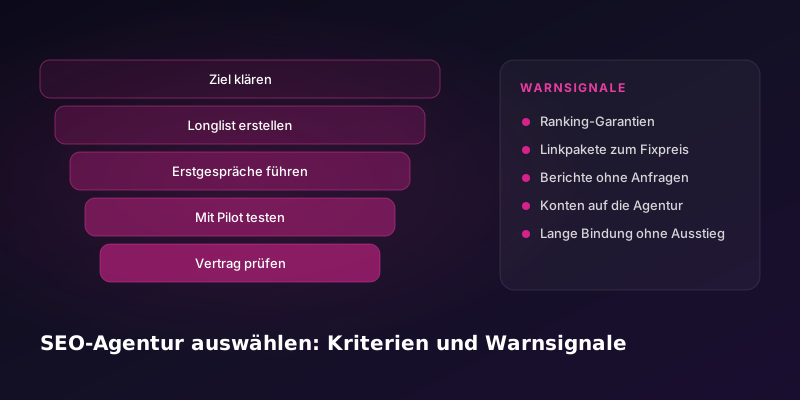
Finding an SEO agency: five steps to a decision
- Define your goal: What should search bring you? Inquiries, orders, job applications? For which services and regions? Without a goal, you cannot compare offers.
- Build a longlist: three to five providers from recommendations, search results and comparisons. Check whether they show projects similar to yours.
- Hold first meetings: use the questions from the next section. Pay attention to who asks questions and who only presents.
- Start small: an analysis or audit package as a pilot before you commit for longer.
- Review the contract: put term, cancellation, access and ownership of content in writing.
What questions should you ask in the first meeting?
These twelve questions quickly show whether a provider works professionally. Google recommends some of them too.
- Which references can you show me, and may I contact them?
- What experience do you have in my industry and my region?
- What results do you expect in what time frame, and what do you base that on?
- How do you measure success, and which metric is at the top of the monthly report?
- Can you show me an anonymized report from another client?
- Who exactly works on my project, and who is my contact person?
- Will you inform me about every change to the website and explain why?
- Where do the links and mentions you build come from?
- Do you follow the Google Search Essentials and spam policies?
- How do you measure whether my company is mentioned in ChatGPT, Perplexity and Google AI Overviews?
- Who owns content, accounts and data if we end the collaboration?
- What contract term and notice period apply?
Also pay attention to the questions you are asked. Google advises looking for another provider if there is no visible interest in your business. A good provider wants to know what makes your offer special, who your competitors are and how your customers find you today.
Red flags: ranking guarantees, bought links, opaque reports
Google is clear here: no one can guarantee a number one ranking. Google warns about providers who guarantee rankings, claim a "special relationship with Google" or offer "priority submission" of a website. Google also recommends caution with unsolicited emails and with programs that promise link popularity or submit your website to thousands of search engines (Google Search Central).
Add to that red flags from practice:
- Reports only show positions for terms nobody searches for, or an index with no link to inquiries.
- The agency wants to set up accounts such as Search Console, Analytics or Google Ads in its own name.
- Changes to the website are made without informing you.
- You are asked to add a link to the agency on your website. Google warns about this too.
Keep in mind: you are ultimately responsible for everything an agency you hire does on your website. If it violates the spam policies, Google can, in the worst case, remove your website from its index.
Freelancer, agency or in-house: what fits your business?
The choice depends less on the size of the provider than on the scope of the task and on how much know-how should stay inside your company.
| Freelancer | Agency | In-house team | |
|---|---|---|---|
| Often a fit for | SMEs with a clearly defined task, such as technical work or copywriting | SMEs and mid-sized companies with several topics at once | Companies with SEO as an ongoing task and their own web development |
| Budget range | Rather small, depending on hours | Medium, usually as a monthly package | Highest fixed cost due to salaries and tools |
| Coverage | Usually one focus area | Technical, content, links, measurement, often GEO and ads as well | Depends on team size, often with external support |
| Dropout risk | High, one person | Low, cover within the team | Medium, know-how depends on a few people |
| Know-how in the company | Partly stays with the freelancer | Stays with the agency unless documented | Stays in-house |
A mix often makes sense: an internal team or a responsible person steers, and an agency handles technical work, measurement and specialist tasks. If you have done everything yourself so far and are hitting limits, SEO consulting is a good intermediate step: you keep the implementation and bring in the strategy from outside. What an agency costs is covered in the guide what an SEO agency costs.
Choosing a GEO agency: how to spot real experience
Many agencies now offer GEO or LLMO, meaning optimization for AI answers. These questions show whether there is real experience behind it or just a new name for SEO:
- How do you measure AI visibility? A sound approach uses a fixed set of questions (prompts) that is run regularly and several times per AI system. AI answers vary from query to query, so a single screenshot says little.
- Which AI systems do you measure? ChatGPT, Perplexity, Gemini and Google AI Overviews give different answers and use different sources.
- How is the result reported? As the share of answers that mention your company, not as "number one in ChatGPT".
- What do you do outside my website? AI systems also rely on mentions in media, directories and portals.
- Which documented examples can you show, with measurement method and time frame?
Google also states in its guidance that advice on optimizing for AI features should follow the official Google Search guidelines. How a clean measurement setup works is explained in the guide measuring AI visibility. For an overview of providers, see the comparison of GEO agencies in Switzerland.
Can an SME handle GEO in-house?
Largely, yes. According to Google, there are no additional requirements for its AI features: the same fundamentals apply as for regular search (Google Search Central). If you keep your website technically clean, answer your customers' questions clearly and describe your offer, region and contact persons unambiguously, you lay the foundation yourself. For classic SEO, too, Google writes that small local businesses can probably do most of the work themselves.
It gets harder with measurement across several AI systems, building mentions outside your own website and working out which questions matter in the first place. This is where outside help pays off, often as an audit with a clear list of measures that your internal team then implements.
Test with a small analysis package
Before you commit for longer, you can test an agency with a clearly defined task. An analysis or audit shows you how thoroughly it works, how clearly it explains its findings and whether its recommendations fit your business. Google advises giving an agency only read access to Search Console for an analysis, and expecting realistic improvement suggestions with an estimate of the effort from an audit.
At SEOX, you can start with the free analysis for a first impression, and the SEO audit and the GEO/LLMO audit are available as fixed-price packages.
What should be in the written contract?
- Term and cancellation: How long are you committed, and with what notice can you leave?
- Scope of services: What is included in the monthly price, and what is billed extra?
- Ownership of content: Texts, graphics and pages created for you belong to you.
- Accounts and access: Search Console, Analytics, Tag Manager and ad accounts are registered to your company, and the agency gets access.
- Reporting: Which metrics, how often, in what format?
- Changes to the website: Who approves them, and how are they documented?
- Handover at the end: Which documents, data and access you receive when the contract ends.
Already working with an agency and unsure whether it does a good job? An independent SEO second opinion helps before you renew or switch.
Updated: November 9, 2026 · Author: Baris Gündogdu, founder of SEOX GmbH
Sources: Google Search Central, Do you need an SEO?, developers.google.com; Google Search Central, AI features and your website, developers.google.com. Retrieved on November 9, 2026.