
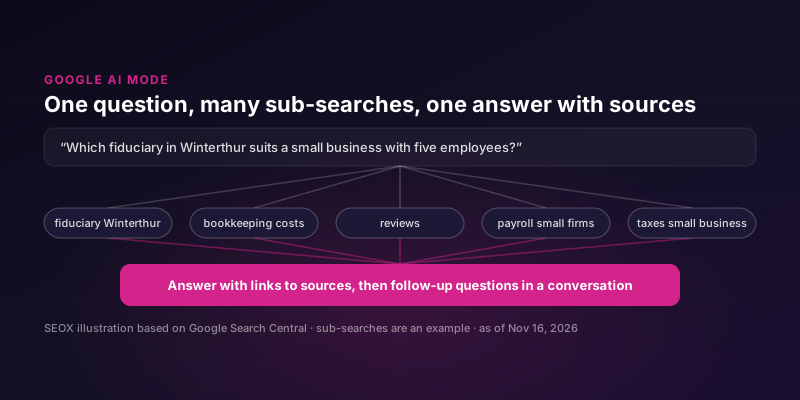
- Google AI Mode is a separate space in Google Search. An AI answers your question in a conversation, with follow-up questions and links to websites. To do this, it splits the question into sub-questions and searches for each of them at the same time.
- AI Mode is available in Switzerland, and according to Google's help center also in German, French, Italian and Romansh (accessed November 16, 2026). Ads in AI Mode are not available here yet.
- In an experiment with 1,100 people in the US, the click-through rate to external websites fell by 18.8 percentage points when every search ran in AI Mode (arXiv, August 18, 2026). Google itself describes total clicks from Search as relatively stable.
- Google writes that optimizing for AI search is “still SEO”. You do not need special files or markup. What counts is indexable pages with your own expertise. For local businesses and online shops, the business profile and product data come on top.
Besides AI Overviews, the AI summaries at the top of the search results, Google has a second AI space: AI Mode. This guide explains what AI Mode is, how it differs from AI Overviews and classic search, and where things stand in Switzerland. Then it turns to the question businesses care about: what changes for visibility and clicks, and what can you do? The summaries at the top of the results page are covered in our guide to Google AI Overviews. All figures are given with source and date. Where we make an assumption, we say so.
What is Google AI Mode?
Google AI Mode is an AI mode of Google Search: you ask a question in full sentences and get a written answer with links to websites. You can ask follow-up questions, and the AI keeps the context. According to Google, AI Mode uses the latest Gemini models and understands images as well as text; with “Search Live” you can also talk to it (search.google, accessed November 16, 2026). On the same page, Google calls AI Mode experimental and says it may make mistakes.
You reach AI Mode at google.com/ai, through the “AI Mode” option after a search on google.com, or on the home screen of the Google app (Google Search Help, “AI Mode”, accessed November 16, 2026).
How AI Mode builds an answer: query fan-out
Google calls the process “query fan-out”: the question is split into subtopics, and a search runs for each subtopic at the same time. The answer is built from the results. This is described in Google's help center and on Google Search Central, which says that both AI Overviews and AI Mode may use this technique (Google Search Central, “AI features and your website”, accessed November 16, 2026). Google does not disclose how many searches run per question or how the results are weighted.
For a business, this means a question like “Which fiduciary in Winterthur suits a small business with five employees?” can trigger sub-searches for location, service, cost and reviews. Which sub-searches actually run cannot be seen from the outside. The example is for illustration and is an assumption.
How many people use AI Mode?
Google gives a big number: after one year, AI Mode has more than one billion monthly active users, and AI Overviews more than 2.5 billion (Sundar Pichai, Google I/O, May 19, 2026). A measurement of search behavior paints a different picture. In the US, only 0.34 percent of Google searches ended up in AI Mode from January to April 2026, measured in Similarweb's web panel, without the Google app (SparkToro, June 9, 2026).
Our reading: the two figures do not rule each other out. Many people open AI Mode at some point in the month, but most searches still run through the normal results page. We have not found usage figures for Switzerland.
AI Mode, AI Overviews and classic search: the difference
AI Overviews are short AI summaries at the top of the normal results page. AI Mode is a separate space for longer conversations. Google describes AI Overviews as a way to get to the gist of a topic quickly. AI Mode, it says, is particularly helpful when further exploration, reasoning or complex comparisons are needed (Google Search Central, “AI features and your website”, accessed November 16, 2026).
| Classic search | AI Overviews | AI Mode | |
|---|---|---|---|
| What you see | Results page with links, ads and other elements such as maps | AI summary with links at the top of the results page, with the normal results below | Its own view with a written answer, links to sources and follow-up questions in a conversation |
| How you get there | Search box | Appears on its own for some searches | Open it on purpose: “AI Mode” option, google.com/ai or the Google app |
| Counting in Search Console | Clicks, impressions and position per result | The whole overview occupies one position, and all links in it get that same position | Positions as on a results page; each follow-up question counts as a new search |
| Ads in Switzerland | Search ads as usual | Ads above and below the overview possible; ads inside the overview not listed for Switzerland | Not available: Switzerland is missing from Google's country list, and English is the only language listed |
Sources for the table: Search Console Help on the Performance report and Google Ads Help on ads in AI Overviews and AI Mode, both accessed November 16, 2026. The same entry condition applies to AI Overviews and AI Mode: a page has to be indexed and eligible to appear in Google Search with a snippet to be considered as a link. According to Google, there are no additional requirements or special optimizations (Google Search Central, “AI features and your website”, accessed November 16, 2026).
Google AI Mode in Switzerland: status as of November 16, 2026
AI Mode is available in Switzerland. Switzerland is on the country list in Google's help center, and German, French, Italian and Romansh are on the language list. What else is documented and what is not:
| Question | Status | Source |
|---|---|---|
| Is AI Mode available in Switzerland? | Yes, Switzerland is on the country list | Google Search Help, “AI Mode”, accessed November 16, 2026 |
| In which national languages? | German, French, Italian and Romansh are on the language list | Google Search Help, “AI Mode”, accessed November 16, 2026 |
| Does it work in German with a Swiss location? | Yes. Our test question in German with a Swiss location returned an AI Mode answer | Our own query, November 16, 2026 |
| Since when? | On October 7, 2025, Google announced more than 40 new countries and territories, “including many across Europe”, but does not name Switzerland. We have not found an official launch date for Switzerland | blog.google, October 7, 2025 |
| Are there ads in AI Mode? | No. Switzerland is missing from the country list, and English is the only language listed | Google Ads Help, accessed November 16, 2026 |
| Can you see AI Mode in Search Console? | Partly. The Generative AI report has been available to all websites worldwide since August 31, 2026 | Search Central Blog, June 3, 2026, with update |
| How many people in Switzerland use AI Mode? | Not published, as far as we can see | – |
What remains open is how many clicks Swiss websites lose or gain through AI Mode. The studies in the next section come from the US and Germany. Google's help center also notes that the settings it describes are being updated, so things can change quickly.
What changes for businesses
Fewer clicks when AI Mode takes over the search
The cleanest measurement so far comes from an experiment. In March 2026, researchers from the University of Pennsylvania and Northeastern University ran a preregistered field experiment with 1,100 people in the US. One group searched as usual, a second group without AI features, and a third was redirected to AI Mode for every search. In the AI Mode group, the click-through rate to external websites fell by 18.8 percentage points compared with normal Google Search. Without AI Overviews, it rose by 8.8 percentage points. In AI Mode, participants stayed longer per session but rated the search experience lower and trusted the information less (Wang et al., arXiv, August 18, 2026).
The study states its own limitation: it forces every search into AI Mode. In everyday life, people open it voluntarily, and in the US they rarely do so yet (see the 0.34 percent above). The result shows the direction if AI Mode is used more often. It does not measure what a single website loses today.
Google disputes the reading that visits are falling. Liz Reid, head of Google Search, wrote that total organic click volume from Search to websites was relatively stable year over year and that Google was sending slightly more “quality clicks”, meaning clicks after which users do not quickly come back (blog.google, August 6, 2025). Google has not published figures for AI Mode alone.
Which sources AI Mode cites
For Germany, Sistrix analyzed millions of AI Mode answers. An answer contained about 15 source links on average. About 40 percent of answers linked to a YouTube video, followed in second place by a Google service, mostly its translation feature. Wikipedia was linked in about 17 percent of answers, and Reddit ranked fifth. The 50 most frequent domains in AI Mode overlapped heavily with the 50 most frequent domains in normal search (Sistrix, October 27, 2025, in German).
A second Sistrix study with 82,619 prompts over 17 weeks in six countries shows how unstable the sources are. AI Mode replaced 56 percent of its sources every week, ChatGPT 74 percent. AI Mode drew 80 percent of its sources from German-language sites and cited a median of 14 to 16 domains per answer, compared with 3 to 4 for ChatGPT (Sistrix, April 28, 2026, updated October 13, 2026, in German). Switzerland is not one of the countries studied.
What we conclude, as an assumption: if you rank well in normal search, you also have a good chance in AI Mode, because the most frequent sources overlap heavily. A single spot check says little, though, because the sources change from week to week.
Local providers: answers built from business profiles
On November 16, 2026, we asked AI Mode “Treuhänder in Winterthur für ein kleines KMU finden” (find a fiduciary in Winterthur for a small business) in German with a Swiss location. The answer named five fiduciary firms with star rating, address, a link to the website and a short description. All five were backed by their Google Business Profile. After that came criteria for choosing and a follow-up question about the exact need.
This is a single query, not a study. It does match what Google itself writes: AI answers can include products and information about local businesses, and Merchant Center feeds and Google Business Profiles can help products and services become visible in AI responses and in other Google Search results (Google Search Central, guide to optimizing for generative AI features, accessed November 16, 2026).
What businesses can do for AI Mode
Google says it plainly in its own guide:
“Optimizing for generative AI search is optimizing for the search experience, and thus still SEO.”
What Google writes in that guide and on its page about AI features, and what it means in practice:
| Topic | What Google says | What it means in practice |
|---|---|---|
| Requirements | There are no additional requirements and no special optimizations for AI Overviews and AI Mode. A page has to be indexed and eligible to appear with a snippet. | Check that your important pages are indexed. Pages with noindex or nosnippet cannot be shown as links. |
| AI files such as llms.txt | New machine-readable files, AI text files or Markdown versions are not needed. Google Search does not use them. | An llms.txt file does nothing for Google Search. For other AI systems it can be a separate topic. |
| Structured data | Structured data is not required for AI search but still worth using as part of SEO. | Keep your existing markup. According to Google, there is no special “AI schema”. |
| Writing style | Content does not need to be broken into small chunks or written specially for AI. | Write for people, not for a model. |
| Content | Original, expert-led content that adds value beyond common knowledge. A good page experience. | Publish your own figures, case studies, price ranges and experience that cannot be found elsewhere. |
| Business profile and product data | Merchant Center feeds and Google Business Profiles can make products and services visible in AI responses. | Keep your profile complete and current, and ask for reviews. Online shops maintain their product data in Merchant Center. |
| Manipulation | Inauthentic mentions across the web help less than you might think. Creating many pages mainly to manipulate rankings or AI answers violates the spam policies. | No bought mentions, no mass pages for every question. |
From this we derive an order of work for businesses in Switzerland. This is our assessment, not a statement by Google:
- Check the technical basics: Are your important pages indexed, and are they allowed to appear with a snippet? Search Console shows this.
- Publish complete offer information: Google names comparisons as a strength of AI Mode. If you want to be compared, you need one page per service with a price range, service area, lead times and conditions.
- Maintain profiles and feeds: a Google Business Profile with current details and reviews, plus Merchant Center for online shops.
- Answer the questions from your sales conversations: In AI Mode, people ask follow-up questions. The questions that come up in sales conversations belong on your website with clear answers.
- Measure before you invest more: how is explained in the next section. It also shows whether AI Mode tends to cite videos, directories or websites for your topic.
Nobody can guarantee that you will be mentioned in AI Mode. Google does not disclose how sources are weighted, and according to Sistrix a large share of the sources changes every week. Anyone who promises otherwise is promising more than Google itself does.
How to measure your visibility in AI Mode
Search Console: the Performance report and the Generative AI report
Clicks and impressions from AI Mode appear in the normal Performance report under the “Web” search type, together with all other searches. A click on an external link in AI Mode counts as a click, position is calculated as on a results page, and a follow-up question counts as a new query. Experiments in Search Labs are not included in the data (Search Console Help on the Performance report, accessed November 16, 2026). The help center does not describe a filter that shows AI Mode alone.
Since June 3, 2026, there has also been a Generative AI report, available to all websites worldwide since August 31, 2026 (Search Central Blog, June 3, 2026). It shows how often links to your website were shown in generative AI features in Search, meaning AI Overviews and AI Mode, broken down by page, country, device and date. The country breakdown shows Switzerland separately. The report does not show clicks, and if your site has few impressions it may not appear at all (Search Console Help, accessed November 16, 2026).
Your own test questions
Google does not share which questions real users ask in AI Mode. That is why you need your own test questions: typical questions from your customers, asked and evaluated regularly. You record whether you are mentioned, with which link, next to which competitors and based on which sources. Because, according to Sistrix, more than half of the sources change every week, a one-off check is of little value. We run this measurement with our own tool, aimaco.ai. Even so, it remains a sample. How to measure AI visibility across several systems is explained in our guide Measuring AI visibility.
What AI Mode means for your business
AI Mode is available in Switzerland, in all four national languages. How much it is used here has not been published; in the US its share of all searches is still small. If more people use it, clicks are lost, according to the best measurement so far. Even so, Google says you do not need a separate AI Mode project. Work on your SEO basics and on complete offer information pays off in normal search and in AI Mode.
In the same guide, Google also describes AI agents that carry out tasks on behalf of people. How such agents find and choose providers is explained in our guide AI agents: what they are and how they choose companies. If you want to check how Google and other AI systems present your company today, we start with the GEO/LLMO audit. Ongoing support is described on the page LLMO, and our full AI offering is on the page AI marketing agency.
Sources: Google Search Help, “AI Mode” (support.google.com/websearch/answer/16011537), accessed November 16, 2026; search.google, “AI Mode”, accessed November 16, 2026; Google Search Central, “AI features and your website” and “Optimizing your website for generative AI features on Google Search”, accessed November 16, 2026; Search Console Help on the Performance report and on the Generative AI report, accessed November 16, 2026; Search Central Blog, June 3, 2026; Google Ads Help on ads in AI Overviews and AI Mode, accessed November 16, 2026; blog.google, October 7, 2025 (AI Mode expansion) and August 6, 2025 (Liz Reid); Sundar Pichai, Google I/O keynote, May 19, 2026; SparkToro, June 9, 2026 (Similarweb data, US); Wang et al., “AI in Search Reduces Publisher Referrals Without Improving User Experience”, arXiv 2608.18352, August 18, 2026; Sistrix, October 27, 2025 and April 28, 2026 (updated October 13, 2026); our own test query in AI Mode with a Swiss location, November 16, 2026. Some of the sources are in German.