
- An AI agent is software that takes on a goal from a person and plans and carries out the necessary steps itself: searching, comparing, using tools, all the way to an inquiry or booking.
- A chatbot answers questions, and an AI assistant helps with thinking and writing. An agent acts.
- Usage is small today: 15 percent of respondents in Germany, Austria and Switzerland have already used an AI agent when shopping, and 5 percent would trust it with the entire purchase (University of St. Gallen, June 2026).
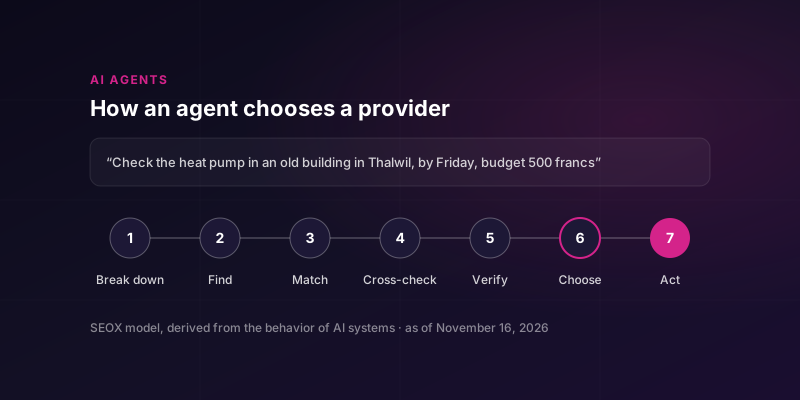
- When agents look for providers, they go through seven steps. A company can drop out at each step, and at each one it can do something about it.
A lot is written about AI agents, mostly from the point of view of the companies that build them. This guide first explains what an AI agent is, how it differs from a chatbot and an assistant, and how far the technology has actually come as of November 2026. Then it turns to the question that matters more for companies in Switzerland: when an agent looks for a provider on behalf of a customer, how does it find your company, and why does it choose you or not? All figures are given with source and date. Where we make an assumption, we say so.
What is an AI agent?
An AI agent is software based on a large language model that takes a goal, breaks it down into steps on its own, carries them out and checks the result. The person says what they want to achieve. The agent decides how to get there.
An example: “Find me someone by Friday to check the heat pump in our old building in Thalwil, budget 500 francs.” To do this, an agent looks for providers, reads their websites and reviews, checks service area, price and availability, and finally presents two or three suggestions with reasons. If the website allows it, it sends the inquiry straight away.
Technically, most agents work in a loop:
- Understand the goal: The agent reads the task and asks if anything is unclear.
- Plan: The language model decides which intermediate steps are needed.
- Act: It uses tools such as web search, calendars, forms or the interfaces of other services.
- Check: It evaluates the interim result and repeats the loop until the goal is reached or it has to ask the person for a decision.
“Agent” describes a way of working, not a particular product. The same AI service can simply answer in one conversation and, in the next, act as an agent that opens several websites and fills in a form.
AI agent, chatbot and AI assistant: the difference
The difference lies in who acts. A chatbot answers within a fixed scope. An AI assistant helps the person, who then acts themselves. An AI agent takes over the acting, with the person's permission.
| Chatbot | AI assistant | AI agent | |
|---|---|---|---|
| What it does | Answers questions on a fixed topic, for example on a company website | Answers open questions, writes, summarizes, researches on request | Takes on a goal and carries out several steps itself |
| Who acts in the end | The person | The person | The agent, with the person's approval |
| Tools | Usually none or a few, built in | A few, such as web search | Many: search, websites, forms, calendars, interfaces |
| Example | “What are your opening hours on Saturday?” | “Which heat pumps are suitable for old buildings?” | “Book me a heat pump inspection by Friday, 500 francs at most” |
If you are planning a chatbot for your own website, you will find the use cases in our guide AI chatbots for businesses. This article is about the other direction: agents that access your company from the outside.
Examples of AI agents: shopping, booking, research
Three areas of use appear in almost every announcement by the major providers. They are at different stages.
Shopping
An agent looks for products, compares prices and delivery times and, at best, fills the shopping cart. Google offers buying directly in AI Mode and Gemini via the Universal Commerce Protocol, but not for customers in Switzerland. OpenAI withdrew buying directly in ChatGPT in March 2026 and has since sent shoppers to the merchant's website. Our guide agentic commerce in Switzerland describes the situation on each platform.
Booking
For hotels and food delivery, the platforms are already specific. In May 2026 Google extended the Universal Commerce Protocol to hotels and food delivery, with partners such as Booking.com, Expedia, Accor, Marriott, DoorDash and Uber Eats, initially via waiting lists (PPC Land, May 20, 2026). Several hotel booking systems say they are opening up to agents. For restaurants, hairdressers or medical practices, we found no comparable interface from the well-known booking systems as of mid-November 2026.
Research and choosing a provider
This case affects every company, even without a shop. The agent does not buy; it puts together a shortlist: three fiduciaries in Winterthur, two providers for a new website, five hotels for a seminar. Whether and how a company ends up on that list is decided in the seven steps further down. In B2B, the market research company Forrester expects AI agents to influence three quarters of purchase decisions in 2027 (Forrester, October 21, 2026, prediction).
How widespread are AI agents today? The state of play in November 2026
AI agents are used little today, and none of the sources we have read put a figure on complete purchases made by agents. The technology is growing fast; people's behavior is changing more slowly. The documented figures:
| Figure | What was measured | Source |
|---|---|---|
| 15% have already used an AI agent when shopping online, 5% would trust it with the entire purchase | Survey of almost 3,000 people in Switzerland, Germany and Austria, not broken down by country | University of St. Gallen, via Netzwoche, June 25, 2026 |
| 2% of online retailers have a strategy for AI or agentic commerce and are implementing it | Online retailer survey 2026, 473 shops, 90% based in Switzerland | FHNW, via Netzwoche, September 15, 2026 |
| ChatGPT brings online shops less than 0.2% of their total traffic | 973 shops, August 2024 to July 2025 | Frankfurt School, June 22, 2026 |
| More than 30 European card issuers have processed live payments made by agents | Announcement without volume figures; Switzerland is not mentioned | Visa, July 2, 2026 |
| Business profiles in ChatGPT (“Business Hub”) in beta, company agents only for eligible companies in the US | Product announcement | OpenAI, November 10, 2026 |
Forecasts and dissenting voices
The forecasts are high. McKinsey expects 3 to 5 trillion dollars of retail revenue worldwide to be driven by agents by 2030 (Digital Commerce 360, October 20, 2025). Gartner expects around 90 percent of B2B purchases to run through AI agents by 2028, on condition of reliable data feeds (Digital Commerce 360, November 28, 2025). The reports do not say how these figures were calculated.
There are clear dissenting voices. In May 2026 Forrester wrote that real autonomy is rare and that the hype is running ahead of customer behavior (Forrester, May 28, 2026). In March 2026 Forrester had advised retailers to invest very little until the channel proves its value. Gartner expects more than 40 percent of projects with AI agents to be scrapped by the end of 2027 and calls many offerings “agent washing”: old software with a new label (Reuters via The Star, June 25, 2025).
Our view: forecasts are forecasts. For Swiss companies, agents will not yet be a revenue channel you can budget for in 2027. The groundwork already pays off today, though, because the same information an agent needs is also needed by Google, ChatGPT and human customers.
How AI agents find and choose companies: the seven steps
An AI agent chooses a provider in seven steps: it breaks down the request, collects candidates, matches their offer, checks third-party sources, looks for evidence, chooses two to five companies and initiates the inquiry. At SEOX we derived this model from the observable behavior of the systems. It is an assumption, not an official description by any provider. No platform discloses exactly how its agent weighs things.
The starting point is always a situation, not a search query: “I need someone by Friday to check a heat pump in an old building in Thalwil, budget 500 francs.”
| Step | What the agent does | Where a company fails | What you can do |
|---|---|---|---|
| 1 Break down the request | Turns the situation into sub-questions: service, location, deadline, price, special requirements | The company does not know these questions | Collect real customer questions, in your customers' own words |
| 2 Find | Collects candidates from the search index, business profiles, feeds and websites | The company is missing from these sources or listed incorrectly | Website indexed, profiles on Google, Apple and OpenAI maintained, the same information everywhere |
| 3 Match | Checks for each candidate whether the offer fits every sub-question | Information is missing or too vague | One page per service with price range, service area, lead times, conditions and exclusions |
| 4 Cross-check | Reads third-party sources: reviews, media, directories | Third-party sources say nothing or contradict | Collect reviews, align directories, appear in the media that get cited |
| 5 Verify | Looks for evidence behind claims: certificate, reference, price | Claims stand without proof | Link every important claim to evidence that can be found, or remove it |
| 6 Choose | Names two to five companies with reasons | A competitor is better documented in steps 3 to 5 | Measure regularly whether and how AI systems mention you |
| 7 Act | Passes on a link or phone number, fills in an inquiry, later also a booking | The way to an inquiry is long or cannot be used by agents | Short inquiry path, forms that agents can read, visits from AI systems measured separately |
What your company can do at each step
Step 1: Know your customers' questions
Agents work with whole situations, not with two search terms. If you want to align your offer with these situations, you need to know them. The best sources are usually already in-house: sales conversations, inquiry emails, quotes, questions to customer service, the search on your own website and the search terms in Google Search Console. From these you build a catalog of 50 to 150 typical customer situations, which every further step works with.
Step 2: Be found
Today agents mainly draw their candidates from search indexes and business profiles. A BrightLocal study with 60,970 queries in the US, the UK and Australia shows that for local businesses Google most often cites the Google Business Profile (28.6 percent of all citations), whereas ChatGPT most often cites Yelp. Around 93 percent of the cited domains were websites of individual businesses (BrightLocal, August 26, 2026). So your own website remains the most important source, and the systems weigh sources differently.
The business profile in ChatGPT is new. According to the OpenAI help page (accessed November 13, 2026), online businesses can claim a profile wherever ChatGPT is available. Local shops and restaurants can only claim existing listings in the US for now. Whether your website is technically readable for agents is covered in our guide Agent readiness: how to make your website findable for AI agents.
Step 3: The offer matches the request exactly
For every sub-question, the agent looks for a clear answer: What exactly is done, and for whom? Roughly what does it cost, and what does the price depend on? Which service area, which lead times? What does the company explicitly not do? If none of this is on the website, the agent has to guess, and it prefers the provider where it does not have to. What helps is one page per service, supplemented by structured data, and a list of the customer questions from step 1 that you have not yet published an answer to.
Step 4: Third-party sources say the same
The agent checks what a company says about itself against reviews, industry portals, directories and media reports. If these sources say nothing or contradict each other, trust drops. The first step is to find out which third-party sites the AI systems actually cite in your industry and region. Then name, address and services are corrected there, and it is worth actively collecting reviews and appearing in the media that get cited. Our guide How AI search selects its sources describes how AI search systems choose their sources.
Step 5: Claims can be verified
“Leading”, “certified”, “more than 500 satisfied customers”: sentences like these only help an agent if it finds evidence. Forrester expects two thirds of B2B providers to lose deals because buyers cannot verify their claims (Forrester, October 21, 2026, prediction). In practice, this means listing every claim on the website and either assigning evidence to it (a certificate with its issuer, a reference with a name, a case study with figures, a commercial register entry) or removing it.
Step 6: Be chosen, and measure whether you are
Whether an agent mentions you is not something you see in Google Analytics. You have to test it: the customer questions from step 1 run regularly through several AI systems, and the evaluation shows whether you are mentioned, in what position, with what reasoning, alongside which competitors and from which sources. We do this with our measurement tool aimaco.ai. Such a measurement is a sample with our own test questions, because the platforms do not release real user queries. Our guide Measuring AI visibility shows how to measure AI visibility.
Step 7: Be ready to act
At the end, the agent passes on a link, gives a phone number or fills in a form. The shorter the path from mention to inquiry, the more of it is left at the end. Forms with clearly labeled fields, a quote or appointment request in a few steps and a separate channel in your web analytics for visits from ChatGPT, Gemini and Perplexity show what the mentions bring in. Bookings made directly by agents are still in the future for most Swiss service providers. If you run a shop, you will find the details on our page about agentic commerce.
MCP, A2A and WebMCP in brief
Three abbreviations come up in almost every text about AI agents. For most companies they are not a separate project today, but you should know what they stand for.
MCP (Model Context Protocol) governs how an agent accesses a service's tools and data, such as a calendar or a product catalog. Anthropic released MCP in 2024. Since December 2025 it has been a project of the Agentic AI Foundation under the Linux Foundation (AAIF, July 28, 2026).
A2A (Agent2Agent) lets agents from different providers talk to each other, for example a customer's shopping agent with a retailer's agent. Google contributed A2A, and since June 2025 it has been with the Linux Foundation. In April 2026, according to the Linux Foundation, more than 150 organizations supported it (Linux Foundation, April 9, 2026).
WebMCP is a proposal that lets a website explain to an agent in the browser what its buttons and forms do. The draft is published by the W3C Web Machine Learning Community Group, and its editors work at Google and Microsoft (WebMCP, Draft Community Group Report, November 13, 2026). Chrome has been testing WebMCP since version 149 in June 2026 in what is known as an origin trial (Chrome Developers, June 9, 2026). It is not an adopted web standard. Our guide MCP, WebMCP and A2A explained simply covers this in more detail.
Whether an AI agent chooses you is still almost always decided in steps 1 to 6, that is, by content, evidence and third-party sources. A protocol on the website creates no demand as long as no agent queries it.
What AI agents mean for your company
For the next two years, the topic is preparation, not a new revenue channel. That is no reason not to start now. Work on steps 1 to 5 also improves how Google and ChatGPT present you in answers today, and how human prospects read your website. Nobody can guarantee that you will be chosen. Anyone who promises that is selling something the platforms themselves do not promise.
A sensible order that we use in projects:
- Find out where you stand: Measure at which of the seven steps you lose out today. Our agent readiness check clarifies this; what the term means exactly is explained in the glossary under agent readiness.
- Build the foundation: Collect customer questions, publish complete offer information for each service, assign evidence, align profiles and directories.
- Check continuously: Measure every month what AI systems say about you, trace wrong statements back to their source and correct them there.
How we plan marketing for people and agents together is described on our page about agentic marketing. If you are looking for an agency to support you with AI visibility and AI agents, you will find our offer on the page AI marketing agency.
Sources: Netzwoche, June 25, 2026 (University of St. Gallen study); Netzwoche, September 15, 2026 (FHNW online retailer survey 2026); Frankfurt School, June 22, 2026; Visa, press release of July 2, 2026; OpenAI, Introducing businesses in ChatGPT, November 10, 2026; OpenAI help page “Setting up your business on ChatGPT”, accessed November 13, 2026; PPC Land, May 20, 2026; Forrester Press, October 21, 2026; Forrester Blog, May 28, 2026; Digital Commerce 360, October 20, 2025 (McKinsey) and November 28, 2025 (Gartner); Reuters via The Star, June 25, 2025 (Gartner); BrightLocal, August 26, 2026; Agentic AI Foundation, July 28, 2026; Linux Foundation, April 9, 2026; Chrome Developers, June 9, 2026. The seven steps are a SEOX model, derived from the observable behavior of AI systems, not a description by any provider. Some of the sources are in German.