
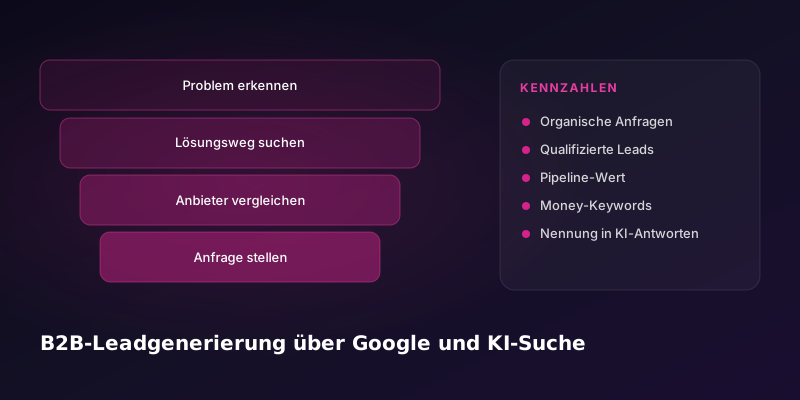
- Organic B2B lead generation means winning inquiries from business customers through unpaid search results and AI answers.
- It becomes predictable when your website answers the questions along the entire buying decision, from the first problem to the choice of provider.
- Products that need explaining need application pages rather than a plain product catalog. You get the knowledge for them by interviewing your specialist departments.
- Success is measured by inquiries and qualified leads from organic search, not by rankings alone.
This guide is for marketing managers at B2B companies whose sales have so far relied on cold outreach, trade fairs and existing customers, and who want to build Google and AI assistants into an additional channel for inquiries. It shows the path from search query to lead and the metrics you can use to prove to management whether the channel generates pipeline. The matching service is our B2B SEO.
How does a B2B company win inquiries from Google predictably?
By bringing three things together. First, the website covers the search queries that buyers, engineers and managing directors make along their buying decision, with one page that answers each of those questions. Second, every one of these pages is built for an inquiry: with a clear next step, a contact person and a form that takes a minute to fill in. Third, the company is named as a provider in AI answers from ChatGPT, Perplexity or Google when someone asks there for a solution.
Predictable does not mean guaranteed. No one can promise a specific position on Google, as Google itself states in its guidance on choosing an SEO provider. Predictable means you know which questions you cover, which pages bring in inquiries and where you need to do more.
Why cold outreach and trade fairs alone are no longer enough
Cold outreach and trade fairs reach people who are not searching right now. Search reaches the people who are. Anyone with a problem in production or a piece of software to replace does their own research first: on Google, on industry portals and more and more in AI assistants. If your company does not show up in this phase, it often never makes it onto the list of providers who get contacted.
That does not mean sales and trade fairs go away. An organic channel adds inquiries from prospects who come to you on their own and can already name their problem. For sales, these are usually the better conversations.
The B2B search journey: from the problem question to the shortlist
In B2B, a single person rarely makes the decision, and research stretches over weeks. Each phase has its own search queries and needs its own content. The table shows the phases with examples from mechanical engineering and software.
| Phase | Typical search or AI question | Matching content | Metric |
|---|---|---|---|
| Recognizing the problem | "Why do seals wear out at high temperatures?" | Guides, technical articles with a clear answer | Impressions and clicks in Search Console |
| Looking for a solution | "high-temperature seal alternatives PTFE" | Application page for each use case | Clicks, time on page, internal click-throughs |
| Comparing providers | "industrial seals manufacturer Switzerland" or "Which providers are there for …?" | Service and comparison pages, references | Mentions in AI answers, rankings for provider terms |
| Making an inquiry | Brand search, contact page, data sheet | Contact points with a named person, sample or quote request | Form inquiries, calls, booked appointments |
Many B2B websites only cover the last row: a contact page and a product overview. But the inquiries are formed in the phases before. If you are visible there, people will search for you directly later on.
Making products that need explaining visible
Application pages instead of a product catalog
A catalog of model designations rarely ranks, because hardly anyone searches for an item number before they know the provider. People search for the use case, the problem or the standard. So build a separate page for each important use case: What task is the product meant for, under which conditions does it work, what are the alternatives, when is it not the right fit? Pages like these answer exactly the questions engineers and buyers ask, and they give AI systems statements they can cite. The guide on content formats for AI search covers which formats AI assistants process particularly well.
Subject matter experts provide knowledge without writing
The knowledge sits in development, sales and service. The people there have no time to write, but they usually have half an hour for a conversation. This is how a 30-minute expert interview works:
- Beforehand: set the topic and five to eight questions that customers actually ask. Sources for these are search queries from Search Console, questions put to sales and service tickets.
- During the conversation: ask the questions, follow up, collect examples from projects. The conversation is recorded.
- Afterwards: the editorial team writes the article or application page from the transcript.
- Approval: the expert only checks the technical accuracy. This usually takes less time than the conversation.
- Publication with the expert's name and role, so that readers and search systems can see where the knowledge comes from.
Comparison and selection pages in competitive categories
In some categories, especially software, comparison portals and two or three large providers hold the top positions. A fair comparison page of your own helps here: Which criteria matter when choosing, which solution suits whom, where are the limits of your own product? A page like this hits the "comparing providers" phase and is often used by AI systems as a source for selection criteria. Work with transparent criteria rather than running down the competition. The guide SaaS SEO against comparison sites explains how software providers go about it.
Getting recommended as a provider in ChatGPT and AI answers
When someone asks ChatGPT or Perplexity for a supplier, the answer is put together from sources the system finds and considers trustworthy. For your company to be named, it has to be clearly described there: who you are, what you offer, for which industries and in which region. That starts on your own website with unambiguous information and structured data, and continues with mentions in industry sources, association websites, trade media and directories. The guide on digital PR for AI visibility explains how to build these mentions.
For Google's own AI features, Google says there are no additional requirements for appearing in AI Overviews or AI Mode. The same fundamentals apply as for regular search (Google Search Central). If you specifically want to get recommended in AI answers, start by measuring for which questions AI systems currently name competitors and not you.
How can GEO be integrated into existing B2B marketing and sales strategies?
GEO, meaning optimization for AI answers, does not need its own silo. The questions sales hears in first meetings are the same ones prospects asked an AI assistant beforehand. Collect them together with sales, answer them on the website and check regularly whether your company shows up in the answers. This way, sales knowledge and content come together, and sales can point to the pages that are created for search anyway. The guide Winning new customers through ChatGPT explains how to capture inquiries from ChatGPT and other AI assistants and build up the channel.
Industry examples
Manufacturing and mechanical engineering
Here, products sell through use cases, standards and material questions. Good starting points are application pages for each customer industry, technical guides on common problems and pages on certifications. Find out more on the page SEO for manufacturing companies.
One example from our work is Viscom Engineering AG, a Swiss specialist in building automation. The company was hard to find online, and customers came through personal referrals. The work included technical content on topics such as KNX, BACnet and energy management, a new website with reference projects, and technical SEO. According to the Viscom Engineering case study, organic traffic rose by 280% and qualified inquiries through the contact form by 95%, along with top 5 rankings for technical terms such as "Gebäudeautomation Schweiz" (building automation Switzerland).
B2B software
Software is searched for by problem, category, comparison and alternatives. Integration pages come on top, because buyers want to know whether the solution works with their existing systems. Review and comparison portals are themselves an important source for AI answers here. How we do this is described in the section SEO for B2B software.
IT service providers
IT service providers are often searched for by location and service, for example "IT support SMEs Bern" or "Microsoft 365 migration partner". Service pages for each offer and region, case descriptions and visible vendor certifications carry the most weight here.
Consulting
Consulting is a matter of trust. Before making an inquiry, prospects check who the consultants are and which topics they cover. Technical articles published under the person's name, topic pages for each consulting field and clear information about the region help. One example of how such an industry guide can be structured is our article on customer acquisition for insurers. You will find more on the page SEO for consulting firms.
Turning the website from a business card into a lead channel
Many B2B websites are good business cards: company history, products, contact. They become a lead channel when every important page offers a fitting next step. On a technical article, that might be a data sheet or a checklist; on an application page, a sample request or a conversation with a named contact person. Forms only ask for what sales really needs for the first contact. Every inquiry is recorded with its source, so you can see later which pages bring in leads.
The pages SEO for more customer inquiries and conversion optimization describe how visitors turn into inquiries.
Which metrics show whether SEO generates pipeline?
Management wants to know whether the channel brings in revenue. Rankings alone do not answer that. These metrics do:
| Metric | Source | What it tells you |
|---|---|---|
| Organic inquiries per month | Google Analytics 4 (forms, calls, appointments by channel) | Whether search brings in contacts at all |
| Share of qualified leads | CRM, rating by sales | Whether the inquiries fit your offer |
| Pipeline value from organic leads | CRM with the source of the inquiry | How much revenue the channel triggers |
| Visibility for money keywords | Search Console, ranking tool | Whether the terms close to a purchase are moving up |
| Mentions in AI answers | Repeated runs of a fixed prompt set in ChatGPT, Perplexity, Gemini | Whether you are named for provider questions |
The guide Measuring AI visibility explains how to measure mentions in AI answers properly. What matters is that the source of every inquiry is carried through to the CRM. Otherwise, the organic channel stays invisible in your reporting.
How long does it take for organic B2B leads to come in?
There is no fixed number. In its SEO Starter Guide, Google writes that some changes take effect within a few hours and others take several months, and recommends waiting a few weeks before judging the impact. How quickly inquiries follow also depends on your starting point: Does the website already have visibility, how competitive are the terms, how long is your sales cycle? So plan interim goals. First, impressions and rankings for the new pages rise, then clicks, then inquiries.
Updated: November 9, 2026 · Author: Baris Gündogdu, founder of SEOX GmbH
Sources: Google Search Central, Do you need an SEO?, developers.google.com; Google Search Central, Search Engine Optimization (SEO) Starter Guide, developers.google.com; Google Search Central, AI features and your website, developers.google.com. All accessed on November 9, 2026 (German versions).