
- GEO complements SEO, it does not replace it. Google lists no additional technical requirements for AI Overviews and AI Mode; the SEO fundamentals still apply.
- Good Google rankings don't guarantee an AI mention: only 12% of the links cited by ChatGPT, Gemini and Copilot are in Google's top 10 for the same question.
- GEO also needs prompt mapping, direct answers, mentions in third-party sources and its own measurement.
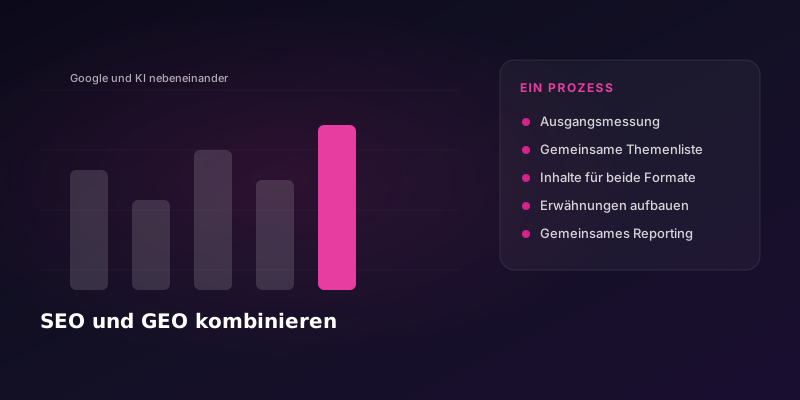
- You combine the two through a shared topic list, one editorial process and one report for both channels.
This guide is for companies with a solid SEO foundation that are missing from ChatGPT or Google AI Overviews, or that are losing clicks despite stable rankings. What GEO is, is explained in the guide What is GEO?; the differences from SEO are covered in LLMO vs. SEO. This article is about building GEO into your existing SEO work, without a parallel project. That is exactly how we work as an SEO and GEO agency and as a GEO agency in Switzerland.
Why don't you appear in AI answers despite good Google rankings?
Because AI systems don't pick their sources by Google's ranking. Ahrefs analyzed 15,000 prompts: on average, only 12% of the links that ChatGPT, Gemini and Copilot cited were in Google's top 10 for the same question. Perplexity was the exception, with almost one in three links (Ahrefs, August 2025).
Two further factors play a role. First, mentions outside your website: in an Ahrefs analysis of 75,000 brands, web mentions were much more strongly linked to visibility in AI answers than the number of backlinks, although this is a correlation (Ahrefs, December 2025). Second, passages that answer a question directly and can be lifted without context. How the systems choose their sources is explained in AI search systems and source selection. If the systems specifically name your competitors, you will find the causes in the guide why ChatGPT recommends your competitors.
How do AI Overviews affect your clicks?
They can reduce clicks on regular search results. Pew Research analyzed the search behavior of 900 adults in the US: people who saw an AI summary clicked on a regular search result in 8% of cases, compared with 15% without a summary (Pew Research Center, July 2025). There is no comparable public study for Switzerland.
In Search Console, you can spot the pattern when positions and impressions stay stable while clicks and click-through rate fall. Google counts visits from AI Overviews and AI Mode as part of the overall search traffic in the "Web" search type (Google Search Central). How AI Overviews work is explained in the guide Google AI Overviews, and how to diagnose a decline in the guide Traffic drop: finding the causes.
What SEO already does for AI visibility
| SEO foundation | Effect on AI visibility |
|---|---|
| Indexing and a clean technical setup | For AI Overviews and AI Mode, a page must be indexed and eligible to show a snippet (Google Search Central) |
| Content that matches search intent | Pages that answer a search query well often also answer the related prompts |
| Structure with headings, lists and tables | Makes it easier to lift individual passages as an answer |
| Authority through links and mentions | Mentions in third-party sources are linked to visibility in AI answers (Ahrefs) |
| Structured data | Helps machines understand the page, but in an Ahrefs controlled study it was no lever for more AI citations |
You should know about the last point before you budget for it: Ahrefs tracked 1,885 pages that added JSON-LD schema and found no notable increase in citations on any platform (Ahrefs, May 2026).
What GEO needs on top
- Prompt mapping: Which questions do your customers ask AI assistants, and which sources show up in the answers? This complements keyword research. More on this under prompt mapping.
- Direct answers: Every section starts with a sentence that answers the question in the heading.
- Sourced figures and quotes: in Princeton University's GEO study, content with added statistics and quotations performed much better, while classic keyword stuffing barely helped (Aggarwal et al., KDD 2024).
- Mentions in third-party sources: trade media, directories and comparison articles that allow AI crawlers. See digital PR for AI visibility.
- Consistent company details: name, offer and location the same everywhere, so the systems can identify you clearly.
- A separate measurement of AI visibility, described in measuring AI visibility.
Combining SEO and GEO in five steps
- Baseline for Google and AI: visibility and clicks from Search Console, plus the mention rate per AI system across a fixed list of questions.
- A shared topic list of keywords and prompts: each topic gets its search terms and the questions customers ask AI assistants.
- Content for both formats: pages that rank in Google and also contain direct answers, tables and sourced figures.
- Build mentions: link work is extended with mentions in media and directories that are cited for your industry.
- Shared reporting: Google and AI metrics in the same report, with the same topics as rows.
Do you need a second agency for this?
Not necessarily. Test your current SEO agency with three questions: Can it measure AI visibility across many queries per system? Does it include prompts in topic planning? Does it build mentions in third-party sources? If all three answers are yes, you don't need a second agency. If something is missing, ask whether it wants to build that capability.
Two separate agencies for SEO and GEO mean double coordination on the same content and two reports you have to merge yourself. That can work if responsibilities are clearly separated. One team that plans both is simpler.
How do you split the budget between SEO and GEO?
There is no fixed split; it follows from the baseline measurement. If your website still has technical or content gaps in Google, the budget goes there first, because GEO builds on indexed, well-structured pages. If you rank well but are missing from AI answers, shift part of it into mentions outside your website and into answer pages.
Don't plan content twice. A well-built guide works for Google and for AI systems. Additional GEO budget mainly goes into measurement, prompt mapping and mentions. You will find our packages on the pricing page. What GEO costs in Switzerland is explained in the guide GEO cost in Switzerland.
How to measure success
| Area | AI assistants | |
|---|---|---|
| Visibility | Impressions and positions in Search Console | Mention rate per system across a fixed list of questions |
| Visits | Clicks and click-through rate in Search Console | Referrals from chatgpt.com, perplexity.ai and similar sources in Analytics |
| Inquiries | Conversions from organic search | A "source: AI assistant" field in the form and in the CRM |
| Content | Rankings per page | Which of your pages are linked in the answers |
How to track where inquiries from AI assistants come from is described in the guide winning new customers through ChatGPT.
Updated: November 9, 2026 · Author: Baris Gündogdu, founder of SEOX GmbH
Sources: Ahrefs, Only 12% of AI Cited URLs Rank in Google’s Top 10 for the Original Prompt, August 11, 2025, ahrefs.com; Ahrefs, Top Brand Visibility Factors in ChatGPT, AI Mode, and AI Overviews (75k Brands Studied), December 12, 2025, ahrefs.com; Pew Research Center, Google users are less likely to click on links when an AI summary appears in the results, July 22, 2025, pewresearch.org; Google Search Central, AI features and your website, developers.google.com; Ahrefs, We Tracked 1,885 Pages Adding Schema. AI Citations Barely Moved., May 11, 2026, ahrefs.com; Aggarwal et al., GEO: Generative Engine Optimization, KDD 2024, arxiv.org.