
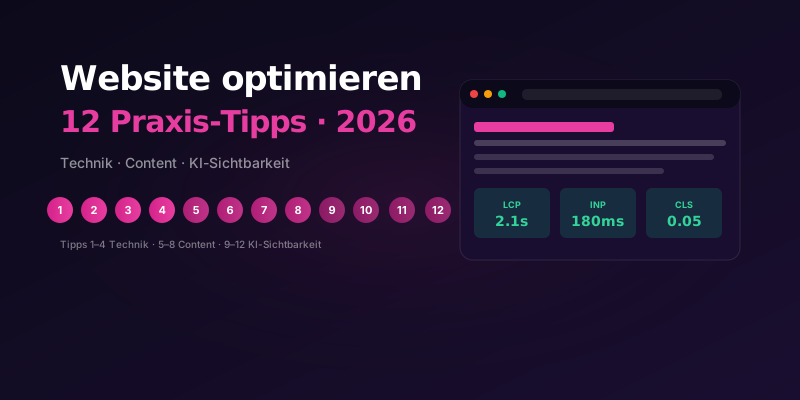
Short answer: Optimizing a website for 2026 means working on four things at once: technical performance (Core Web Vitals), depth of content (E-E-A-T and intent match), classic search engine visibility (Google and Bing) and, new, AI visibility (ChatGPT, Perplexity, Google AI Overviews). If you only pull one of these levers, you leave 30–40% of your reach on the table. This practical guide shows you the 12 most important website optimization tips for 2026, grouped into technical SEO, content and AI visibility.
Technical optimization: 4 tips for performance and indexing
1. Get your Core Web Vitals into the green
Google evaluates three performance metrics: Largest Contentful Paint (LCP) ≤ 2.5 s, Interaction to Next Paint (INP) ≤ 200 ms (replaced FID in March 2024) and Cumulative Layout Shift (CLS) ≤ 0.1. The values are measured at the 75th percentile of 28-day field data (Chrome User Experience Report), not in lab tools such as Lighthouse. Concrete levers: WebP images with width and height attributes, inline critical CSS, load JavaScript via defer or async, fonts with font-display: swap. Tools: PageSpeed Insights, Google Search Console (Core Web Vitals report).
2. Think mobile-first, not “mobile too”
Since 2024, Google indexes only the mobile version (mobile-first indexing). In practice, this means: if your mobile version has less content than the desktop version, that content is effectively missing from Google's index. A common mistake: “show more” accordions that contain text on mobile but hide it with display:none. This is usually fine, but visible text is safer. Touch targets should be at least 48×48 pixels, font size ≥ 16 px and spacing between clickable elements ≥ 8 px.
3. A clean technical setup: HTTPS, sitemap, robots.txt, hreflang
Four essential building blocks that almost all SME websites partly neglect: (1) HTTPS with a current TLS 1.3 certificate, (2) an up-to-date XML sitemap with correct lastmod dates, submitted in Google Search Console, (3) a clean robots.txt that leaves important areas open and blocks test and admin paths, (4) hreflang tags on multilingual sites (DE/FR/IT/EN for Swiss companies), including x-default. A single faulty hreflang reference can knock entire language versions out of the index.
4. Use Schema.org markup strategically, not randomly
Structured data is the direct channel to Google and LLMs. Essential types for an SME website: Organization or LocalBusiness (with address, phone and opening hours), WebSite with SearchAction, Person for authors, FAQPage for question-and-answer sections, BreadcrumbList for deep navigation, and Article or BlogPosting for editorial content. Validating with the Google Rich Results Test and the Schema.org Validator is a must: broken schema is ignored.
Content optimization: 4 tips for visibility and conversion
5. Align content with search intent
Search intent comes before search volume. Today Google ranks pages that answer exactly the question someone asked, not the ones with the most keyword stuffing. Four intent types: informational (“what is schema markup?”), navigational (“seox blog”), commercial investigation (“best SEO agency Switzerland”), transactional (“buy SEO audit”). One intent per page. If you mix informational and transactional intent, you rank poorly for both.
6. Send E-E-A-T signals consistently
Experience, Expertise, Authoritativeness, Trustworthiness: the four pillars Google uses to assess content quality. Practical levers: (1) author profiles with photo, résumé, LinkedIn link and topic specialization, (2) dates (publication and last update), (3) references to authoritative sources (for the Swiss context, for example the Federal Office of Public Health, the Federal Statistical Office or FINMA), (4) a legal notice with full address, commercial register number and FINMA or industry certifications where available. In 2026, E-E-A-T counts twice: for Google rankings and for LLM citations.
7. Internal linking as a support for topical authority
Internal links are an underrated ranking lever. Three rules: (1) every important page should receive at least 3–5 internal links from related pages, (2) choose descriptive anchor texts (“What is GEO?” instead of “click here”), (3) build a hub-and-spoke structure: a pillar article links to 8–12 in-depth subtopics, which in turn link back to the hub. This is how topical authority builds up systematically.
8. Update content, don't just publish it
An article from 2021 with outdated statistics will inevitably slip. In 2026, freshness is a direct ranking signal, and for LLM citations it even dominates. Quarterly audit: which of your top 20 pages have not changed? Update keywords, switch examples to current years, add new studies and data, set dateModified in the schema. Not every page needs a refresh every 90 days, but important money pages should get a content update at least once a year. How to review an entire blog archive is described in our guide content audit in six steps.
AI visibility (GEO/LLMO): 4 tips for the new search
9. Write content as answers that can be quoted
ChatGPT, Perplexity and Google AI Overviews prefer to cite clearly worded, self-contained answers. In practice: not “In this article we show you …”, but the answer straight away: “The Core Web Vitals in 2026 are LCP ≤ 2.5 s, INP ≤ 200 ms, CLS ≤ 0.1.” Rule of thumb: could a paragraph work as an answer on its own, without context? If so, there is a good chance an LLM will cite it.
10. Treat FAQ sections as LLM training data
FAQ sections with FAQPage schema are the most efficient LLMO lever of all. They deliver a structured format: question → short, precise answer. That is exactly the format LLMs need for their own answers. Recommendation: 5–8 FAQ items per relevant money page, with real user questions (from People Also Ask, Reddit, Quora and your own sales conversations). The FAQs appear in Google search results as rich results and are also picked up as a source by ChatGPT and others.
11. Publish your own data and statistics
LLMs prefer to cite original sources. If you publish your own studies, industry benchmarks or data analyses, you become the source for third-party articles and LLM answers. Three pragmatic formats for SMEs: (1) analyze your own client data anonymously (“We analyzed 247 Swiss SME websites …”), (2) industry surveys among your own newsletter subscribers, (3) comparison tests of tools, providers or methods. Made-up numbers are fatal: LLMs increasingly cross-check against several sources.
12. Measure AI visibility, not just Google rankings
In 2026 it is no longer enough to watch Ahrefs or Sistrix rankings. The question is: Is my brand cited in ChatGPT, Perplexity and Google AI Overviews? Specialized tools such as aimaco.ai measure how often a company is named in AI answers to relevant industry prompts, which is today's visibility index for AI search. If you don't measure it, you optimize blind. If you do, you see where search behavior is shifting 6–8 weeks before the classic ranking tools do.
Quick-win order: what should you tackle first?
If you look at these 12 tips and don't know where to start, this order has proven itself at SEOX across 200+ SME audits:
- Week 1: Set up Google Search Console and PageSpeed Insights, document the status quo.
- Weeks 2–3: Core Web Vitals and mobile optimization, the biggest technical lever.
- Week 4: Implement schema markup on the top 5 pages and validate it with the Rich Results Test.
- Month 2: Check the top 10 content pages for search intent, add E-E-A-T signals (author pages).
- Month 3: Build internal linking as a hub structure, add FAQ sections.
- Month 4+: GEO/LLMO setup with AI visibility monitoring, regular content refreshes.
Common website optimization mistakes
Three mistakes we see in almost every second SME audit:
- Performance without content: a website with a 100/100 PageSpeed score that has nothing to say does not rank. Performance is hygiene, not strategy.
- Schema everywhere, validated nowhere: half-finished schema markup with syntax errors is worse than none at all, because Google ignores it completely. Always check it with the Rich Results Test.
- Tools over strategy: if you subscribe to three SEO tools but have no clear strategy, you spend hours looking at data without changing anything. A tool stack ≠ an SEO strategy.
If you need a complete rebuild instead of an optimization, different rules apply. Which relaunch mistakes cost rankings and how to avoid them is covered in the website relaunch checklist.
In 2026, website optimization is not a one-off action but an ongoing process. What works today will be partly outdated in 18 months, especially for AI visibility, where the methods keep evolving.
How do I optimize my website for Google? An overview in three layers
If you want to optimize your website for Google, don't start with individual tips; think in three layers. The first layer is technical SEO: Google must be able to crawl and index your pages without problems, they must work flawlessly on mobile, load fast (Core Web Vitals) and be served over HTTPS. Without this foundation, all content work fizzles out.
The second layer is content: every important page must fully serve one specific search intent, with a clear structure (one H1, sensible H2/H3), internal linking and semantic depth. The third layer is authority and trust (E-E-A-T): author pages, freshness, source references and topically relevant backlinks show Google that your content is credible. In 2026, GEO/LLMO adds a fourth layer: optimization for AI search systems. The 12 tips above are assigned to these four layers; work through them in the order given and you optimize systematically rather than piecemeal.
How do you adapt your SEO strategy to Google algorithm updates?
Several times a year, Google releases major core and spam updates that can shift rankings noticeably. The bad news: you cannot predict every update. The good news: if you focus from the start on what Google rewards in the long run (helpful, original content, clean technical SEO and real authority), you will get through most updates without major drops. Strategies that rely on shortcuts or thin mass content are particularly vulnerable.
In practice, this means a fixed monitoring rhythm: keep track of rankings, organic traffic and Core Web Vitals, analyze the affected pages after an update and make targeted improvements where needed, instead of throwing out the whole concept in a panic. How to tell whether a Google update or another cause is behind a drop is explained in our guide traffic drops and ranking losses. This continuous adjustment is part of professional SEO support. If you want to know how resilient your current site is to updates, a free SEO analysis with a concrete risk assessment helps.
Conclusion: a four-pillar model instead of isolated measures
In 2026, modern website optimization rests on four pillars: technical SEO (Core Web Vitals, mobile, schema), content (intent match, E-E-A-T, freshness), linking (internal hub-and-spoke, curated external links) and AI visibility (GEO/LLMO, FAQs, quotable content). If you only work on one or two of these pillars, you are not on the wrong track, but you are giving away reach. The 12 tips in this article cover all four pillars.
Want to know where your website stands today and which of these 12 tips gives you the biggest lever? A free SEO & GEO analysis answers that in 60 minutes, with concrete priorities for the next 90 days.
Related articles: SEO cost in Switzerland · Best SEO agencies in Switzerland 2026 · What is GEO? · Core Web Vitals explained