
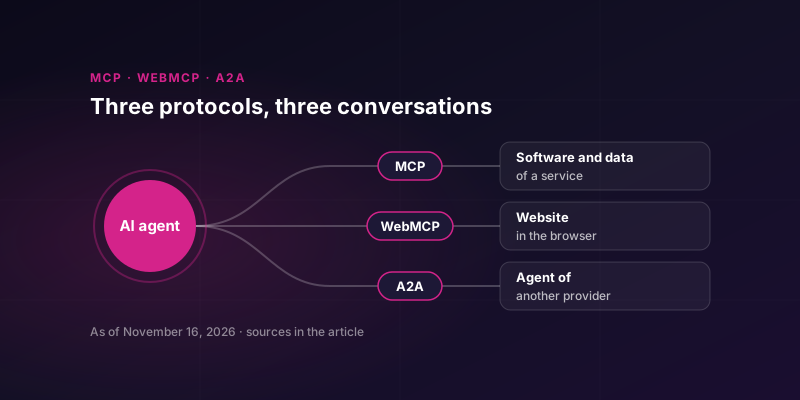
- MCP connects AI applications such as ChatGPT or Claude to software and data, for example a calendar or a database. It is the most mature of the three protocols and has been part of the Agentic AI Foundation under the Linux Foundation since December 2025.
- WebMCP lets a website tell an AI agent in the browser what its forms and functions do. It is a draft that Chrome has been testing since version 149. It is not a web standard.
- A2A lets AI agents from different providers talk to each other. Google developed it, and since August 2026 it has also been part of the Agentic AI Foundation.
- For most companies in Switzerland, none of the three is a project of its own today. Complete offer information, structured data and a technically clean website come first.
Anyone looking into AI agents quickly runs into three acronyms. Most explanations are written for developers and start with JSON-RPC and transport layers. This guide explains MCP, WebMCP and A2A for marketing and business leaders: what each protocol does, who is behind it, how far along it is in November 2026 and whether your company needs to do anything about it today. The topic moves fast. Every statement about status, versions and support therefore comes from a primary source we opened on November 16, 2026, and is cited with its date.
What an AI agent is in the first place, and how it chooses providers, is covered in our guide AI agents: what they are and how they choose companies. This article is about the technology underneath.
Why AI agents need shared protocols
A language model only knows what was in its training data. As soon as it is supposed to add an appointment, check stock levels or request a quote, it has to talk to other software. Until recently, every one of those connections needed its own custom code. When Anthropic introduced MCP, it described the problem like this: even very capable models are “trapped behind information silos and legacy systems,” and every new data source needs its own integration (Anthropic, November 25, 2024).
A protocol is a shared language with fixed rules. Once you speak it, you can talk to everyone else who speaks it too. The three protocols in this article govern three different conversations:
What is MCP (Model Context Protocol)?
MCP is an open standard for connecting AI applications to external systems. Through MCP, applications such as Claude or ChatGPT can access data sources, tools and workflows and use them to get tasks done (modelcontextprotocol.io, accessed November 16, 2026).
The official documentation compares MCP to a USB-C port: just as USB-C connects devices through one standard plug, MCP connects AI applications to other systems through one standard interface. A vendor builds the connection once, and every AI application that supports MCP can use it.
- Who is behind it
- Anthropic released MCP as open source on November 25, 2024. Since December 2025 it has been a project of the Agentic AI Foundation (AAIF) under the Linux Foundation (AAIF, July 28, 2026). The founding platinum members are Amazon Web Services, Anthropic, Block, Bloomberg, Cloudflare, Google, Microsoft and OpenAI (Linux Foundation, December 9, 2025).
- What it is for
- An AI application reads data from another system or triggers a function there.
- Example for a business
- A software vendor offers an MCP server. Its customers can then ask ChatGPT or Claude directly, “Which invoices are still unpaid this month?”, and the answer comes from the vendor's software.
- Who supports it
- The MCP documentation lists Claude, ChatGPT, Visual Studio Code and Cursor (accessed November 16, 2026). According to OpenAI, you can add your own MCP server in ChatGPT through Plugins (OpenAI Developers, accessed November 16, 2026).
- Status today
- In use. The documentation points to the specification version 2026-07-28. According to the AAIF, it is the largest revision since launch and comes with a rule that requires at least twelve months between deprecating a feature and removing it (AAIF, July 28, 2026).
What is an MCP server?
An MCP server is a program that offers a service's data and functions through MCP. It is the side that answers. The specification distinguishes three roles (MCP specification 2026-07-28, accessed November 16, 2026):
According to the specification, a server can offer three things: resources (data and content, such as a product catalog), tools (functions the model may run, such as “reserve an appointment”) and prompts (prepared templates for recurring workflows).
On the question of who stays in control: the specification requires the AI application to get the person's explicit consent before it calls a tool and before it passes the person's data to a server. The protocol itself cannot enforce this. It is up to each application to implement these rules, and the specification says so.
Does my company need its own MCP server?
Your own MCP server makes sense when your customers or your team should work with your data inside an AI application. Typical cases are software companies whose customers want to use the product from ChatGPT or Claude, companies with a booking or ordering system that agents should query directly, and organizations that want to make internal data available to their own staff in an AI assistant. A fiduciary, a hair salon or a trades business without its own software does not need one today. We are not aware of agents querying such businesses over MCP, and the booking software these companies use either includes MCP access or it does not (SEOX assessment).
As a test, seox.ch runs a small MCP server of its own that checks whether a domain appears in AI answers for its industry. Its description is public at seox.ch/.well-known/mcp/server-card.json (checked November 16, 2026). We are measuring how many requests come in that way before we recommend it to clients as a lever.
What is WebMCP?
WebMCP is a proposed web standard that lets a website offer structured tools to an AI agent in the browser (Chrome for Developers, documentation as of October 2026). Instead of the agent guessing what each form field is for, the website tells it: “You can request a room here. I need the dates, the number of guests and an email address.”
The name sounds like MCP, and the idea is related: an application describes what it can do so that an agent can use it reliably. The difference is where it happens. MCP runs between an AI application and a server. WebMCP runs on the website a person currently has open in the browser. According to the Chrome documentation, WebMCP is mainly designed for workflows in the browser with a human in the loop.
- Who is behind it
- The draft is published by the W3C Web Machine Learning Community Group. Its four editors work at Google and Microsoft (WebMCP, Draft Community Group Report, November 13, 2026).
- What it is for
- A website tells the agent in the browser which actions are possible and what information it needs for them.
- Two approaches
- Declarative: an existing HTML form gets extra annotations and becomes a tool. Imperative: developers define tools in JavaScript, for example for navigation or page state (Chrome documentation).
- Example for a business
- A hotel annotates its inquiry form. When a guest asks the agent in her browser, “Request a double room there from March 12 to 14,” the agent fills in the right fields instead of guessing its way through the page.
- Status today
- Testing. Chrome has offered WebMCP as an origin trial since version 149, a time-limited experiment for websites that sign up (Chrome Developers, June 9, 2026). These pages give no end date. The draft says about itself: “It is not a W3C Standard nor is it on the W3C Standards Track.” Google writes that the API may still change.
For website owners, this means that adding WebMCP today is a test. The effort is small if your forms are clean, but the API may change, and Chrome's pages do not name any agent that uses WebMCP for consumers today. seox.ch registers three tools through WebMCP for testing, including appointment booking.
What is A2A (Agent2Agent)?
A2A is an open standard for communication between AI agents. It defines how agents find each other, hand off tasks and exchange results, even when they come from different providers (AAIF, August 17, 2026).
The project website sums up the difference from MCP in one line: “MCP connects an agent to tools, APIs, and data. A2A connects it to other agents. Use both.” (a2a-protocol.org, accessed November 16, 2026). MCP is the wire from the agent to the software. A2A is the conversation between two agents, each bringing its own tools.
- Who is behind it
- Google developed A2A, and the Linux Foundation hosted it afterwards (Linux Foundation, April 9, 2026). Since August 17, 2026, A2A has been a project of the Agentic AI Foundation, under the same roof as MCP (AAIF, August 17, 2026).
- What it is for
- Agents from different companies work together: one makes a request, the other handles part of the task and reports back.
- Agent Card
- An agent introduces itself with an Agent Card, a machine-readable document with its name, capabilities, address and authentication rules (A2A specification 1.0.0, accessed November 16, 2026).
- Example for a business
- A company's purchasing agent asks a wholesaler's agent for prices and delivery times instead of reading the wholesaler's website. The wholesaler's agent answers with reliable data from its own system.
- Status today
- First stable version 1.0 since March 2026 (AAIF, August 17, 2026). More than 150 organizations support A2A; Microsoft has built it into Azure AI Foundry and Copilot Studio, and AWS into Amazon Bedrock AgentCore (Linux Foundation, April 9, 2026). The Linux Foundation reports production use in enterprises; it gives no figures on use by consumers.
Another example from our own site: seox.ch publishes an Agent Card for its visibility check at seox.ch/.well-known/agent-card.json (checked November 16, 2026). What an Agent Card means for service businesses and how we implement it is described on our page about agent readiness.
MCP, WebMCP and A2A compared
The three protocols do not compete. They cover different connections and can be used side by side. Table as of November 16, 2026, sources as in the sections above.
| MCP | WebMCP | A2A | |
|---|---|---|---|
| Purpose | AI application uses a piece of software's data and functions | Website offers actions to the agent in the browser | Agents from different providers work together |
| Who talks to whom | AI application ↔ a service's server | Agent in the browser ↔ open website | Agent ↔ agent |
| Who is behind it | Anthropic, Agentic AI Foundation since 12/2025 | Google and Microsoft, draft in a W3C community group | Google, Agentic AI Foundation since 08/2026 |
| Maturity | In use, version 2026-07-28 | Testing in Chrome from version 149, not a standard | Version 1.0 since 03/2026, mainly in enterprises |
| What a company needs | Its own software or data to be used in AI applications, plus developers | A website with forms or workflows and access to the code | Its own agent or a platform that outside agents should work with |
Does my company need to do anything now?
For most companies in Switzerland, the honest answer is: not for the protocols themselves yet, but for the foundations underneath them, yes. A protocol is a pipe. It only helps once an agent uses it and finds something useful at the other end. The overview below is our assessment, not a rule from any platform.
| Your situation | Relevant today | What you can do |
|---|---|---|
| You sell software or a platform | MCP yes, consider A2A | Plan an MCP server if your customers work in ChatGPT, Claude or developer tools; A2A if your product is itself an agent |
| You run an online store or a booking system | Partly | Ask the vendor of your store or booking system what it offers for agents; test WebMCP on your inquiry form |
| You are a service business (fiduciary, trades, medical practice, consulting) | Hardly | Get your offer information, structured data and website technology in order; protocols later |
| You want to use AI internally with company data | MCP yes | Agree with IT which systems may be connected via MCP and who approves access |
What comes first
Before a protocol pays off, an agent has to be able to understand what you offer from your website. Three things decide this, and they work right away because Google, ChatGPT and human visitors benefit from them too:
- Clean offer information: For each service or product, it is clear what it is, who it is for, where, at what price or price range and how to request it. If a detail is missing from your website, no agent can pass it on.
- Structured data: Schema.org markup for your organization, services, products, opening hours and reviews makes this information machine-readable. Our schema markup guide shows how.
- Website technology: Content sits in the HTML rather than appearing only after JavaScript runs, forms have clearly labeled fields, and AI crawlers are not blocked by accident. The building blocks are covered in detail in our guide optimizing your website for AI agents.
Only then do files and interfaces built specifically for agents come into play. If you start on them today, treat it as preparation. Nobody can guarantee that it will bring more inquiries, because no platform discloses how its agent weighs this kind of information.
Related terms in brief
llms.txt is a text file, not a protocol. On September 3, 2024, Jeremy Howard proposed using a file called /llms.txt to provide information that helps agents use a website (llmstxt.org). What it does and does not achieve is covered in our guide llms.txt and structured data.
ACP and UCP are protocols around purchases made by agents. Which platform uses which, and what is available in Switzerland, is covered in our guide agentic commerce in Switzerland.
Agentic Resource Discovery (ARD) defines how agents find and verify catalogs of an organization's capabilities. Details are in our article Agentic Resource Discovery.
Short definitions are in our glossary under Model Context Protocol and A2A. How we plan marketing for both people and AI agents is described on our page about agentic marketing.
Sources, all opened on November 16, 2026: Anthropic, Introducing the Model Context Protocol, November 25, 2024; Linux Foundation, formation of the Agentic AI Foundation, December 9, 2025; Agentic AI Foundation, MCP graduates to enterprise infrastructure, July 28, 2026; modelcontextprotocol.io, introduction and specification version 2026-07-28; OpenAI Developers, MCP documentation; Linux Foundation, A2A surpasses 150 organizations, April 9, 2026; Agentic AI Foundation, A2A joins AAIF, August 17, 2026; a2a-protocol.org, overview and specification 1.0.0; Chrome Developers, WebMCP origin trial, June 9, 2026; Chrome for Developers, WebMCP documentation, as of October 2026; W3C Web Machine Learning Community Group, WebMCP Draft Community Group Report, November 13, 2026; llmstxt.org, September 3, 2024. Information about seox.ch comes from the website's public files, checked November 16, 2026. The section “Does my company need to do anything now?” is an assessment by SEOX.