
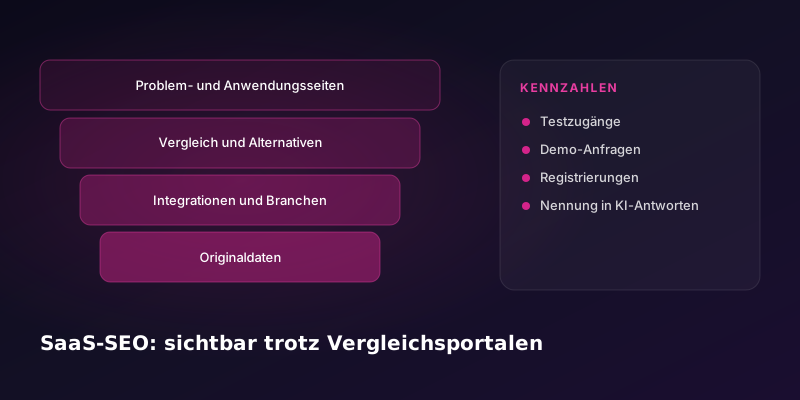
- SaaS SEO means making software visible in Google and AI answers along the problem, the category, comparisons and alternatives.
- You catch up with comparison sites using four page types: problem and use case pages, your own fair comparison pages, integration and industry pages, and original data.
- The comparison sites themselves are part of the strategy: a well-maintained profile with reviews is a source that searchers and AI systems read.
- Success is measured by trials, demo requests and sign-ups from organic search, not by rankings alone.
This guide is for marketing and growth leads at software companies whose category on Google is dominated by comparison sites and two or three large competitors. It shows which pages help you catch up, how to get mentioned in AI answers and how to measure success. The matching service is our B2B SEO for software companies.
What is SaaS SEO?
SaaS SEO is search engine optimization for software sold as a subscription service. It makes software visible where buyers search: for their problem ("track working hours without Excel"), for the category ("time tracking software"), for comparisons ("time tracking software comparison") and when looking for an alternative to a well-known product. Unlike with an online shop, the journey rarely ends with a purchase on the page, but with a trial, a demo or a sign-up.
Why comparison sites dominate software search
Comparison sites answer exactly the question many buyers ask in the selection phase: which solutions exist, and how do they differ? They cover entire categories, have many reviews and are often linked from other websites. That is why Google often treats them as a good result for comparison queries. This is not a flaw of the comparison sites; it is a matter of search intent.
For software companies, this means that competing against a comparison site with a single product page rarely works. It works better to cover the search queries that a comparison site doesn't answer or answers only superficially, and at the same time to be well represented on the comparison sites themselves.
The four page types that help SaaS companies catch up
| Page type | Search intent | Example search | What to measure |
|---|---|---|---|
| Problem and use case page | Solve a problem, understand the solution | "organize team vacation planning" | Clicks, sign-ups from this page |
| Comparison and alternatives page | Weigh up solutions | "alternative to [product]", "[category] comparison" | Rankings for comparison terms, demo requests |
| Integration and industry page | Does the solution fit my systems and my industry? | "[category] with [accounting software]", "[category] for fiduciaries" | Clicks, trials from this target group |
| Original data | Figures and orientation | "[topic] benchmark Switzerland" | Mentions and links from other websites, mentions in AI answers |
Problem and use case pages
Before anyone searches for "software", they search for their problem. Pages that answer this problem thoroughly and show your software as one way to solve it reach prospects earlier than any comparison site. A dedicated page for each important use case, with concrete workflows and screenshots, works better than a general feature overview.
Your own comparison and alternatives pages
Your own comparison pages only work if they are fair. Readers quickly notice when a comparison only praises your own product. This checklist helps:
- Disclose the criteria you compare by.
- State an "as of" date and update the comparison regularly.
- Say who your solution is not a good fit for.
- Describe competitors factually, without disparaging them.
- Only take information about other products from their public sources.
Integration and industry pages
Many buyers look for a solution that works with their existing systems or is already used in their industry. A dedicated page for each important integration and each target industry answers these questions directly. Such search queries are specific and often less competitive than the category itself.
One example from Switzerland is Lensio AG. Its software connects to the accounting software bexio and shows revenue, expenses and liquidity in ready-made dashboards; fiduciary firms can offer the dashboards under their own brand (according to lensio.ch). For a product like this, a page on the bexio integration and a page for fiduciaries as a target group are obvious entry points. SEOX supports Lensio with SEO and content.
Original data
Your own analyses, such as anonymized usage data or a customer survey, deliver figures that don't exist anywhere else. Other websites and media quote such data, and AI systems use it as a source. What matters is a transparent method: who was surveyed, when, and how many?
Presence on the comparison sites: profile, reviews, categories
If comparison sites occupy the search results, a good profile there is part of the strategy. Check whether your software is listed in the right categories, whether the description, prices and features are up to date and whether satisfied customers write reviews. Comparison sites are also sources that AI assistants can evaluate when asked for software recommendations. How to build such mentions outside your own website systematically is described in our guide to digital PR for AI visibility.
SaaS SEO and AI answers: getting named in category recommendations
If someone asks ChatGPT or Perplexity "Which software do you recommend for X?", the answer usually names a handful of products. Whether yours is among them depends on how clearly your software is described in the sources the system finds: your website, comparison sites, trade articles, comparisons. Why competitors are often named instead and what you can do about it is explained in the guide Why ChatGPT recommends your competitors.
The first step is a list of the questions your buyers ask AI assistants, mapped to pages that answer those questions. That is prompt mapping. On your own website, structured data helps describe the software unambiguously. Google offers the SoftwareApplication type for this (Google Search Central).
Which metrics count for SaaS
Rankings are an intermediate step. For management, what counts are trials, demo requests and sign-ups from organic search and, if your CRM allows it, the deals that result from them. Measure them by page type, and you will see whether problem, comparison or integration pages bring the best leads. In addition, track how often your software is named in AI answers using a fixed set of questions that you check regularly.
One example of software where sign-ups were the goal is the club management software LocalClubs. There, the launch ran through paid channels: a campaign across social media, Google Ads and display, with separate campaigns for German-speaking and French-speaking Switzerland. According to the LocalClubs case study, more than 100 sign-ups came in during the first days of the campaign. The metric is the same for SaaS SEO; only the channel differs.
One partner instead of five agencies
Growing software companies often have a separate agency for each area: website, copy, SEO, ads, analytics. That costs coordination, and no one is responsible for the result across all channels. A partner that handles strategy, search, content and measurement together sees which pages and channels bring sign-ups and can move the budget there. This applies whether your website is built with Webflow or another system.
How SaaS SEO fits into a B2B strategy for inquiries is described in the guide B2B lead generation through organic search. Our offer for software companies is on the page SEO for B2B software.
Updated: November 9, 2026 · Author: Baris Gündogdu, founder of SEOX GmbH
Sources: Google Search Central, structured data for software apps (SoftwareApplication), developers.google.com, accessed November 9, 2026; SEOX case study LocalClubs, seox.ch/en/case-studies/localclubs; Lensio, product information on lensio.ch, accessed November 9, 2026.